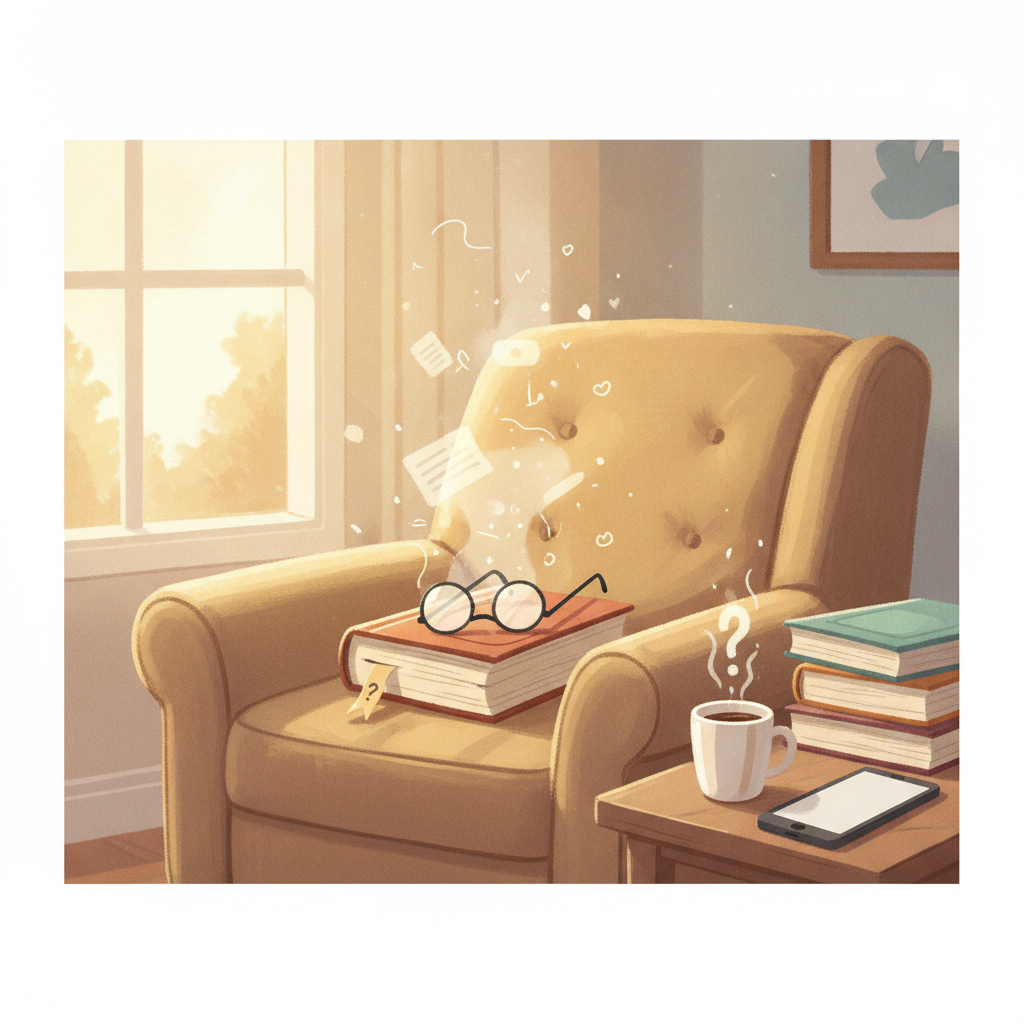
Someone closes a book on a Sunday night certain that Monday will look different. They underlined three passages, dog-eared a page, maybe texted a friend the best line. By Wednesday the certainty is gone, and the week runs on the same rails it always has. This happens to nearly every serious reader, and it isn’t because the books were bad or the reader wasn’t paying attention. It’s because reading and changing are two different skills, and finishing a book only proves you did the first one.
Recognition Is Not Retrieval
Peter Hollins spends part of The Self-Learning Blueprint on a distinction that sounds almost too simple to matter: recognizing an idea when you see it again is not the same as being able to produce that idea, unprompted, when you need it. Most reading trains only recognition. You nod at a sentence about discipline or attention, feel the little click of agreement, and move on. The click is real, but it’s cheap; it costs nothing and it changes nothing on its own. Hollins argues for a more expensive move instead: stopping to repeat the idea back in your own words, in a full sentence, because doing so “requires you to process the information natively and chew on its meaning,” which is what actually lodges it somewhere retrievable. Skip that step and the idea sits in the book, not in you, no matter how many times you’ve read the page.
This lines up with something psychologists mean by self-regulation, or what gets called self-mastery: not raw willpower, but the ability to direct your own behavior toward a goal on purpose, over and over, especially when the easier option is right there. That ability doesn’t come from knowing the goal exists. It comes from having practiced reaching for it under conditions that resemble the ones you’ll actually face. A person who has read about discipline has a description filed away. A person who has practiced calling that description back up at 6 a.m. When the bed is warm has a procedure. Only the procedure survives contact with Wednesday. The description, however well written, just sits there being true.
The Remix Test
Music makes the same split easier to see because you can hear the difference. A producer doesn’t get fluent in a genre by listening to a thousand records straight through, however carefully. Fluency shows up when they take four bars, loop them, chop the sample at a different point, and rebuild the drum pattern around it until the phrase behaves the way they need it to. The listening was necessary. It was not sufficient. What made the genre theirs was the part where they stopped consuming it and started handling it, and that handling is what a listener can’t get from playback no matter how good their headphones are. A record collection is a library of recognition. A finished track is proof of retrieval.
It’s worth sitting for a second with what this implies about the large language models that now read more books in an afternoon than a person reads in a lifetime. A model trained on a library that size has, in one sense, “read” all of it. But the pattern only becomes usable at the moment of generation, when the system has to reconstruct something from what it absorbed rather than simply having absorbed it. Training is the listening. Generation is the loop. The interesting part isn’t that machines now do something like reading at a scale no human can match; it’s that even at that scale, storage and use turn out to be separate problems, requiring separate work, exactly as they do for a person with one book and a Sunday evening. Scale changes the size of the library. It doesn’t change what turns a library into a habit.
None of this argues for reading less, or for treating books as raw material to be strip-mined for takeaways before you’re allowed to enjoy them. Clayton Christensen’s account of disruption makes a related point from the other direction: incumbents don’t fail from ignorance, they fail because doing the thing they already know how to do is cheaper than building the muscle for something new, right up until the cheap option stops working. Reading without retrieval practice is the personal-scale version of that. It’s cheap, it feels productive, and it works fine until the moment you actually need the idea and discover you only ever recognized it.
The fix isn’t a better book. It’s what happens in the ten minutes after you close one: saying the idea back in your own words, out loud if you can stand it, or writing down the single thing you’ll do differently, by name, with a date attached, instead of trusting the underline to do the remembering for you. That ten minutes is unglamorous compared to the hours you spent reading, and it’s the only part of the whole exercise that has ever changed anyone’s Wednesday. A shelf holds every idea you’ve ever met and loses none of them. Only your hands decide which ones get to leave the shelf.
Leave a Reply