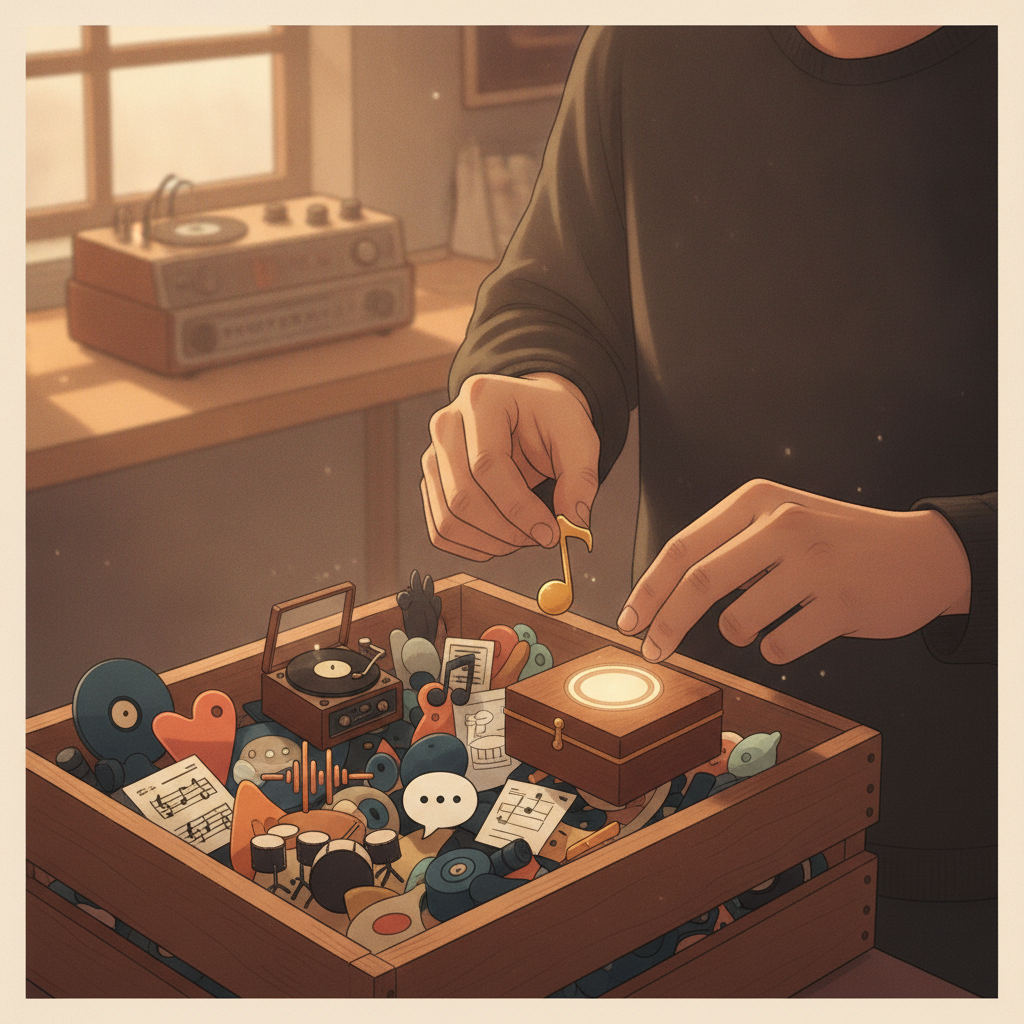
The E-mu SP-1200, the drum machine behind a generation of hip-hop records, could hold roughly ten seconds of sound. That was the total. A producer had to decide which snare, which vocal stab, and which slice of a dusty soul record earned a place in memory, and everything else got thrown out. The records that came out of that box still sound like decisions, which is more than most tracks made with unlimited storage can claim.
That’s the thought I keep coming back to this weekend. Constraint is what turns abundance into expression. Take the walls away and the work doesn’t get freer. It gets blurrier.
Ten Seconds Forces a Verdict
Producers who worked on those machines describe the same routine: dig through hundreds of records, hear something good, then ask whether it deserves to stay. The limit did the editing before the music started. A sample that survived had already beaten a dozen rivals for the space.
A sampler with an hour of memory asks nothing of you. You can keep the snare and the second-best snare and the third, and you’ll still be auditioning them at midnight. The choosing doesn’t go away. It just moves later, where it’s harder to do and easier to skip.
The Federal Reserve Runs on Two Objectives
The same shape shows up in places that have nothing to do with music. The Federal Reserve, whose every move gets the sort of Financial Times coverage of the Federal Reserve that fills a full news cycle, works from two stated goals: maximum employment and stable prices. That’s it. The most consequential economic team on earth has a short list.
The list isn’t the hard part. The hard part is that the two goals sometimes pull against each other, and someone has to pick which one gets the weight this quarter. A short list doesn’t remove the tension. It makes the tension visible, and you can’t argue about a tradeoff you can’t see.
Product teams that work well tend to follow the same discipline. They keep to a handful of objectives, often just one to three, and they check progress against them every week. The objectives don’t cover everything the team does. They cover what the team has agreed matters, and that agreement is the actual product of the exercise.
Unlimited Output Moves the Problem
Creative AI is the sampler with the memory limit removed. A model can generate a thousand instrumentals before lunch, each one competent, each one plausible, and none of them costing the maker a single hard choice. The old bottleneck, ten seconds of memory or one afternoon of digging, is gone.
So the scarce thing changes. It was never the storage or the generation. It was the verdict. Someone still has to listen to the thousand and say that this one is the record and the rest are noise, and that call takes taste, which nobody can install.
There’s a quieter cost, too. Abundance wears people out. I saved a line this week from someone writing about coming back to the real world after being overwhelmed, and the feeling in it was familiar: too much arriving, too little decided. A feed with no limit produces the same tiredness a sampler with no limit does. Nothing is wrong with any single item. The pile is the problem.
Knowing Is Not the Same as Changing
A model has read more than any producer ever heard, and it hasn’t been changed by any of it. That’s a strange sentence to write, but I think it’s the useful one. Knowing a lot and being transformed by what you know are separate events, and only the second one looks like wisdom.
A producer who flips a 1970s soul record was moved by it first. The sample is evidence that something landed. Two seconds of a singer’s breath, looped and pitched down, carries the producer’s whole reaction to hearing it. That’s why the loop feels like a person even when the record it came from is fifty years old.
This is also why talent matters more than tooling. The quality of the people you attract and keep defines the team, and in a world where generation is nearly free, the person who can say no is the rare hire. Anyone can now produce output. Far fewer people can look at a thousand options and know which nine hundred and ninety-nine to cut.
Where the Limit Goes
Small tools are getting more powerful every month, and I’m glad about that; the people who couldn’t afford a studio can now afford a good idea and a laptop. That’s a real gain, and it deserves to be named plainly. But the gain only pays out if the maker brings back the constraint on purpose.
That means setting a ten-second limit nobody else imposed. Pick one objective for the week. Keep three tracks out of the thousand. Write down what the piece is for before asking a model to make it, because the model will happily make anything, and “anything” is the one thing nobody wants to hear.
The old machines didn’t make better music because they were worse. They made better music because they made you choose. Ten seconds was never the limit on the music; it was the editor, and now you have to hire one.
Leave a Reply