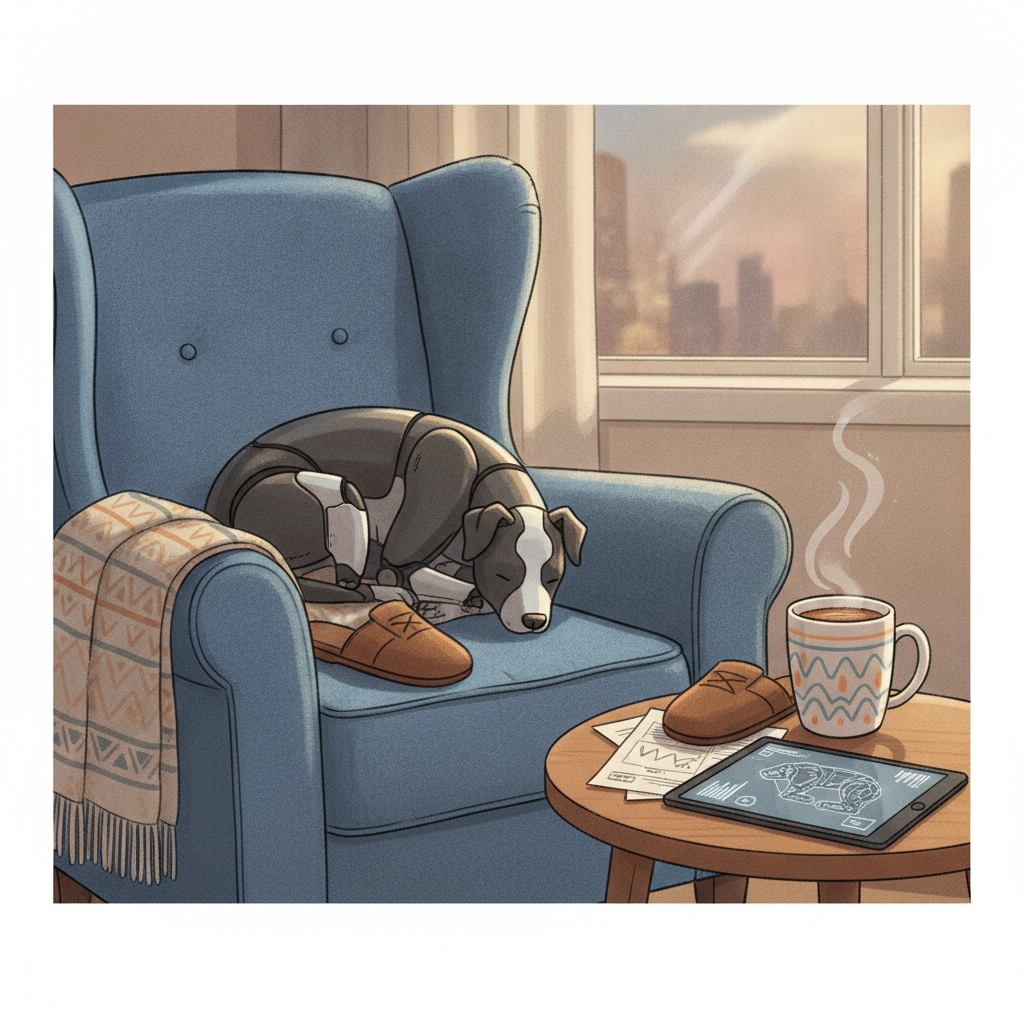
Ben Lamm spent the past few years trying to bring back the woolly mammoth. His newest venture breeds a different kind of animal. Warhound, Lamm’s latest company, has raised $200 million to engineer autonomous war dogs and arm them with gear from Anduril, the defense contractor that already builds drones, interceptors, and command software for the Pentagon. The round values a company with no shipped product around a premise the entire defense industry now shares: the next edge in warfare belongs to whichever machine can carry a weapon and decide, on its own, when to use it.
Drones fly themselves. Ships patrol themselves. Now dogs patrol themselves. Once every branch of warfare races toward the same capability, the interesting question is not who builds the sharpest autonomous agent. It is who still gets paid once everyone can build one.
That question already has an answer playing out one step removed from the battlefield, in the ordinary market for the same kind of agent. Wherever autonomous software multiplies across an industry, the price of the work it does tends to collapse, because each new agent competes against the cost of running a script, not the cost of paying a person. The war dogs and that civilian collapse are not two separate stories. They are the same mechanics observed from opposite ends of the same chain.
Capital rushes toward Warhound because deploying an autonomous agent inside a narrow, defensible niche, one dog, one weapons mount, one contract with a government that does not shop on price, still commands a premium. Turn the same kind of agent loose on an open market, and it does the opposite: it pushes the price of the work toward zero, because nothing prevents a competitor from fielding an equivalent agent for less. One end of this chain pulls money in. The other end pushes the return on that money out.
An autonomous agent captures value wherever it operates: build the dog, win the contract, keep the margin. Clayton Christensen and Michael Raynor complicate this in The Innovator’s Solution, where they trace how commoditization in one part of a supply chain forces a mirror process to open up somewhere else in that chain. As Christensen and Raynor put it, “The attractive profits of the future are often to be earned elsewhere in the value chain, in different stages or layers of added value.”
Apply that to armed autonomous machines and the picture most investors are pricing changes shape. Once several defense contractors field a version of the same thinking, shooting hardware, the margin in building that hardware starts to erode the same way it erodes in the civilian story above. The money involved does not disappear. It migrates to whichever layer of the chain has not yet been commoditized: the targeting software, the sensor data that trains it, the integration work that makes one company’s gear talk to another’s chassis.
Capital that bet on the dog itself is a bet on a layer of the chain that history says will not hold its margin for long.
If that migration runs the course it has run in every other hardware category that commoditized, defense robotics should start to resemble what already happened to cloud servers and smartphones. The physical machine, the dog, the drone, the hull, would stop being where the money lives, and the margin would move up to whoever owns the layer above it: the models that choose a target, the pipeline that trains those models, or the contracts that stitch one firm’s autonomous dog into another firm’s broader weapons system.
Warhound and Anduril could end up supplying something close to commodity hardware while a handful of companies nobody can name yet collect a toll on every decision the dog makes once it is in the field. The investors behind this round are probably not betting that the dog holds its margin forever. They are betting on being first in line for whichever company owns the next, uncommoditized layer.
The $200 million is not wasted even if the dog never holds a durable margin of its own. It is money unmoored, drifting toward whichever layer of the chain has not yet given up its profit, and the firm that guesses correctly where that layer sits will make more from the guess than Warhound will ever make from the dog.
Leave a Reply