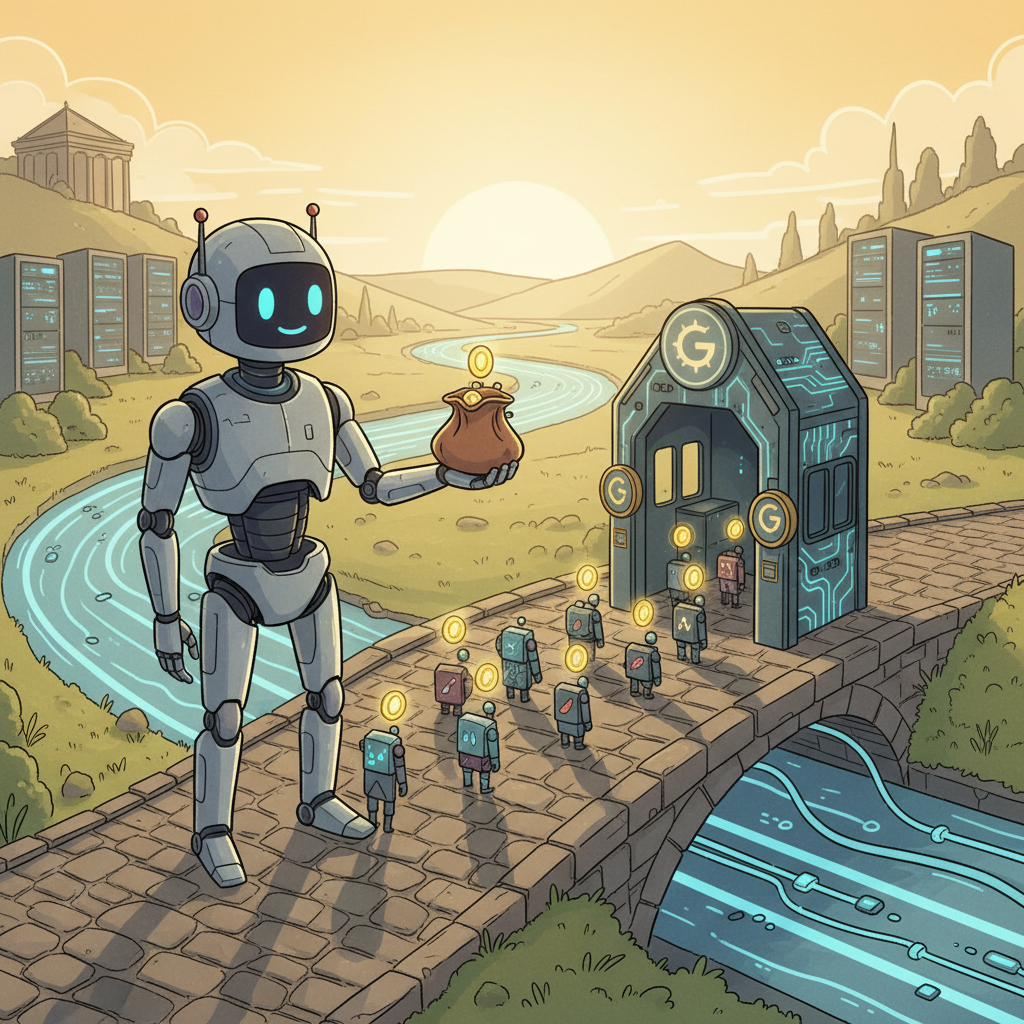
The Solana Foundation said this week that it is teaming up with Google Cloud on stablecoin payments for AI agents, and most of the coverage filed it under crypto news. That category undersells what was actually announced. The move treats agents as economic actors that will need to pay each other, for compute, for data, for inference, and for the small services that compose into a larger one, and it treats payment rails as infrastructure those agents will rent rather than build. The second half of that sentence is the part worth sitting with, because almost every other story of the week is also a story about which layer of the agent economy is going to collect the toll. The loud layers are the ones everybody is bidding on. The durable one is usually quieter, and it is almost never the model.
That is the argument, and the rest of this is the evidence for it. A model lead is rented at a rate set by whoever is one release behind you. A position underneath the model is owned. Every announcement in this cycle can be sorted by which of those two things it buys, and once you sort them that way the spending patterns stop looking like a single arms race and start looking like four companies betting on four different floors of the same building.
Start with the biggest check. Microsoft is on track to spend roughly $190 billion on AI infrastructure, and a meaningful slice of its user base is pushing back on having Copilot grafted onto products they liked the way they were, a tension that one widely circulated piece framed as evidence that Apple’s AI restraint looks smart by comparison. $MSFT can absorb the pushback; it has the balance sheet for a five-year detour and the enterprise contracts to wait out a bad year of sentiment. The question was never whether the spend works. The question is what layer the spend buys. Data centers depreciate on a schedule you can look up. Model weights leak in capability across the industry within twelve months, because every frontier result becomes a target the rest of the field optimizes against. Distribution endures, and distribution is the one thing $190 billion of capital expenditure does not automatically purchase.
Apple’s posture is the mirror image, and Jim Cramer put the bull case in his usual blunt shorthand when he said that $AAPL gets paid for AI rather than paying for it. Crude framing, real point. The device is the one part of the stack where latency is solved by physics rather than by infrastructure. Whatever runs on the phone runs at the speed of the silicon under your thumb, and no amount of capital spending elsewhere in the stack closes that gap. Every voice agent that wants to feel instant has to either live there or pay rent to whatever lives there, and the rent is never collected once. It is collected on every session, by every agent, for as long as the device is the thing people pick up.
Then OpenAI shipped GPT-5-class reasoning into real-time voice, which is the same conversation approached from a different floor. Voice agents are the first place where users will tolerate an agent acting on their behalf without watching it do so, because watching a phone call happen is not really a thing you can do. The phone call is the trust threshold. Whoever solves the orchestration layer for voice, meaning turn-taking, interruption, recovery from a misheard word, and knowing when to stop talking, sits at a chokepoint that is harder to dislodge than a model lead, because the behaviors that make voice tolerable are learned from traffic rather than from training runs.
The Five Layers of the Agent Economy
Strip the noise off the week and you have five layers stacked on top of each other: compute, model weights, orchestration, payment rails, and distribution. Each story above is a bet on a different floor, and the bets are unusually legible right now because nobody has bothered to disguise them. Microsoft is spending on the bottom two, which is where the capital requirement is highest and the differentiation window is shortest. Solana and Google Cloud are bidding for the fourth, which is the floor almost nobody was talking about a year ago. OpenAI is reaching for the third, where the product surface and the defensibility happen to coincide. Apple is sitting on the fifth and quietly raising the rent, which is the position that requires the least new spending and produces the least news.
Notice that the two sources describing the spending war and the voice launch disagree without ever addressing each other. The restraint argument says the winner is the company that refused to overbuild and kept the customer relationship. The voice argument says the winner is the company that owns the orchestration layer, wherever the hardware happens to sit. They cannot both be fully right, and the friction between them is the most useful thing either piece contains: one of them is describing a moat made of installed base, the other is describing a moat made of accumulated interaction data, and the next few years are a live test of which kind of moat holds.
What Commoditizes and What Compounds
Most of these floors will commoditize. Compute always does, because the curve of cost per token bends down by an order of magnitude every couple of years, and there is no version of this decade in which that stops. Model capability commoditizes more slowly, but it commoditizes; the gap between the frontier model and the open-weights model that runs on a laptop has narrowed every year for four years running, and nothing about the research pipeline suggests that trend reverses.
Orchestration, payment, and distribution do not commoditize the same way, because they are network effects wearing the costume of infrastructure. The orchestration framework that runs the most agents accumulates the most behavioral data, and that data is exactly what makes the next version better at knowing when to stop talking. The payment rail that settles the most agent-to-agent transactions becomes the default, and defaults in payments have a way of outliving the technology that established them. The device that hosts the most agents becomes the place agents live, and the place agents live is the place the rent flows. Each of those advantages compounds from usage rather than from spending, which is precisely why the company with the largest budget is not automatically the company with the best position.
How Many Agents per Human
Here is the question that nobody is putting in their slide decks: how many agents per human, by 2030? Everything above depends on the answer, and almost nobody states the number they are assuming.
If the answer is one, meaning one assistant per person, basically what we have now, then the spending wars are roughly proportionate to the prize and the toll booth is a modest building. If the answer is fifty, meaning a research agent, a calendar agent, a code agent, a shopping agent, a travel agent, and a finance agent, each one calling four or five sub-agents that handle small specific tasks, then the toll booth math changes by two orders of magnitude and the per-transaction economics of settlement stop being a rounding error. Fifty agents per person making constant small payments to each other is not a payments market that any existing rail was designed for, which is the whole reason a new one is being built.
The reason Solana and Google are interested in the payments piece now is that they have run the second number and decided it is the right one to plan for. Whether they are right matters less than the fact that the concrete is being poured for that scenario, and concrete sets in the shape it was poured. Infrastructure built for fifty agents per human will still be there if the answer turns out to be five, and it will be sitting in the path of every transaction that does happen.
The Signs to Guess By
Thomas Hobbes wrote that the best prophet is the best guesser, and the best guesser is the one most versed in the matters guessed at, for he has the most signs to guess by. Replace prophet with agent and the line gets sharper, because it stops being a claim about wisdom and becomes a claim about inputs.
The agents that work, meaning the ones that actually do useful things and the ones that get trusted with money and decisions, will be the ones with access to the most signs. An agent that can see your calendar, your inbox, your bank, your purchase history, your voice tone, your location, and your stated intent, all in the same context window, will outperform an agent that sees one of those things in isolation, and it will outperform it by a lot. That advantage has very little to do with which model is running underneath, which is uncomfortable for everyone currently spending to win on that dimension. Whoever owns the rails those signs travel over collects something more durable than a model lead.
This is the part of the week worth marking down. The compute spending is loud. The model launches are loud. The voice demo is loud. The payment rail announcement is quiet, a press release in a category most investors mentally file under crypto and skip. The quiet announcements are usually the ones that describe where the position is being built, because a company that has found an uncontested floor has no incentive to draw a crowd to it. The toll booth is rarely the loudest building in town.
Leave a Reply