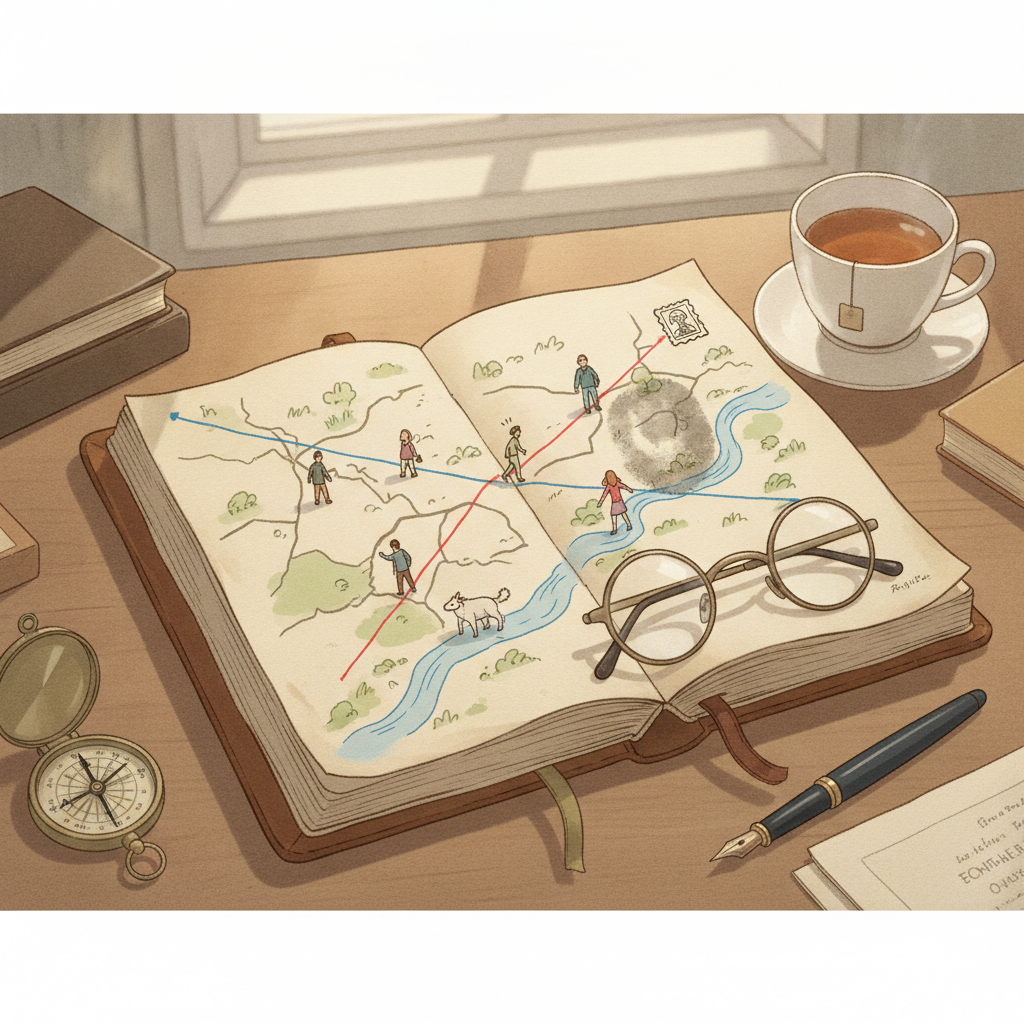
In June 1914, Commissioner Young, Adegboyega Edun, and J. O. George walked to the border between Egba and Iperu to settle a boundary dispute. They carried papers and authority, backed by the quiet conviction that lines on a map could settle what centuries of shared use and occasional violence had not. Two more officials joined them: Duncombe from Ijebu and Bryne, the Egba road engineer. The group was small, the task precise, the confidence high. Everything about the expedition was designed to look like a solved problem walking toward its own confirmation, which is exactly what a story looks like from the inside when it has stopped being tested.
On the walk back, the story broke against the land. We don’t talk much about what happened next in the histories that survive, and the silence itself is part of the record: the accounts that lasted were written by people invested in the version where the papers worked. What we do know is this: the boundary story they carried was not the boundary the people on the ground inhabited. The map was not the territory, and the commissioners were about to find out what that mismatch costs. That is the whole argument of this piece, stated early so the rest of it can earn the claim. A story does not survive because it is true. It survives because it is good at surviving, and the environment that decides its fitness is almost never the environment it describes.
Fast forward a century. The uniforms have changed. The territories are now product roadmaps, market narratives, and model weights. The commissioners are founders in hoodies and product managers with roadmaps, alongside investors chasing the next infinite story. The language has shifted; the instinct has not. We still send people to settle disputes between what we believe and what is actually there, equipped with better tools and the same stubborn certainty that the story can win. The tooling improved faster than the humility did, and that gap is where the interesting failures live.
What the Commissioners Carried
Listen to how the people building the future talk. Their language revolves around infinite potential and making history. Not beating a competitor. Not solving a specific problem well enough that people will pay for it. The horizon they describe is not a place; it is a posture, a promise that the company will be so important that the question of what it actually does becomes irrelevant. That is a remarkable rhetorical achievement when you sit with it, because it converts the absence of a concrete answer into evidence of scale. A company that cannot say what it sells is either early or empty, and the infinite-potential frame is built specifically so that no one in the room has to decide which. This is the meme that is spreading right now, and it spreads because it is good at spreading.
In 1976, Richard Dawkins described the meme as a unit of cultural inheritance, an idea that succeeds not because it benefits the host but because it is good at spreading. The infinite-potential story is a meme in his original sense, and the distinction he drew matters more here than the word’s later internet career suggests. Fitness, in his framing, is measured against an environment, not against reality. The infinite story gets people to write checks and join teams, repeating it on podcasts and in all-hands. It is fit for the environment of modern tech, where attention is the scarce resource and capital follows attention. That doesn’t make it true, and it certainly doesn’t make it useful to the people who hear it and repeat it. A story can be perfectly adapted to the room and completely maladapted to the world the room is trying to operate in.
Inside companies, the same dynamic plays out at the product level. Companies frame opportunities from their own perspective. The product team thinks about what the product can do, not what the person on the other end of the interaction actually needs, and every incentive in the building reinforces that framing, because the product’s capabilities are legible and the user’s needs are not. The roadmap becomes a story the company tells itself about its own importance, and the wider market becomes a backdrop for a movie that only plays inside the building. This is why so many launches feel like they are solving yesterday’s problem with tomorrow’s branding. The branding is current because branding is cheap to update. The problem is stale because updating the problem would mean admitting the roadmap was pointed at the wrong thing.
What the Engineers See
Meanwhile, the engineers who actually ship the software watch from a different angle. They see the errors and failures in LLM-powered applications: confident outputs that are wrong and graceful failures that aren’t graceful at all, along with the gap between the marketing promise and the API response. They know something the story department does not: the system is only as real as the last user interaction, and those interactions are piling up in support tickets that never make it to the quarterly deck. That routing is not an accident. Support tickets are the one channel in a company where the territory speaks in its own voice, and they are also the channel with the least status, which means the signal with the highest fidelity travels through the pipe with the lowest bandwidth. The model does not care about the narrative. It cares about the input and the weights.
What’s interesting is not that the story outruns the facts. That has always been true. What’s interesting is that the stories have gotten so much better at spreading. The feedback loop is tighter now. A founding myth can go from plausible to conventional wisdom in weeks, not generations, because the channels that carry it are optimized for velocity and have no mechanism for retraction. The infinite-potential narrative is more contagious than the “we solve boring problems competently” narrative, so it wins attention and capital, and with them, the talent. The market punishes the boring story even when the boring story is the one that actually delivers. Competence is not anti-viral by accident; it is anti-viral because it is specific, and specificity limits the number of people who can see themselves inside it.
Why Fitness Is Local
That’s the lesson from the boundary commissioners. The story they carried was contagious within its own system: the colonial administration and the reports back to London, along with the career incentives of men who wanted to be the kind of people who settled disputes. Every one of those surfaces rewarded the story for being clean, and none of them had any contact with the ground it described. The land didn’t care. The people who lived there didn’t care. The story broke anyway, because within its native habitat it was highly fit, and a highly fit story is the hardest kind to interrupt. Fitness is local. Truth is not a requirement for survival.
Today’s casualties are quieter. They show up when a startup burns another hundred million on a product nobody asked for, or when a model produces a harmful answer and the team scrambles to patch the gap between the story and the output, with product teams staring at metrics that confirm the narrative while actual users leave. The losses are not bodies but trust, time, and money, and their quietness is the problem. A loud failure corrects the story that caused it. A quiet one lets the story keep recruiting. These failures happen in spreadsheets and Slack channels, not on roads, which means the people best positioned to notice them are the ones with the least incentive to say so.
How to Find the Territory Again
The hard question is not whether the story is true. It is whether you can still see the territory when the story is the only thing anyone around you can talk about. Those are different skills, and only the second one is under your control once the environment has selected its winner.
We have the same temptation now. The infinite-potential story is comfortable. It is fit. It spreads. That is exactly why it deserves the most suspicion, because comfort and contagion are the two things that never appear on the list of reasons someone gives for believing something. The story that wins is not the one that maps the territory best. It is the one that is best at copying itself. And the moment you forget that, you are no longer the commissioner walking the land. You are the map, folded and carried by someone who has never been there.
Keep a notebook of the things the story cannot explain. Not the objections, which the story has already absorbed and has an answer for, but the small stubborn details that do not fit and that nobody around you bothers to mention. That is how you find the territory again.
Leave a Reply