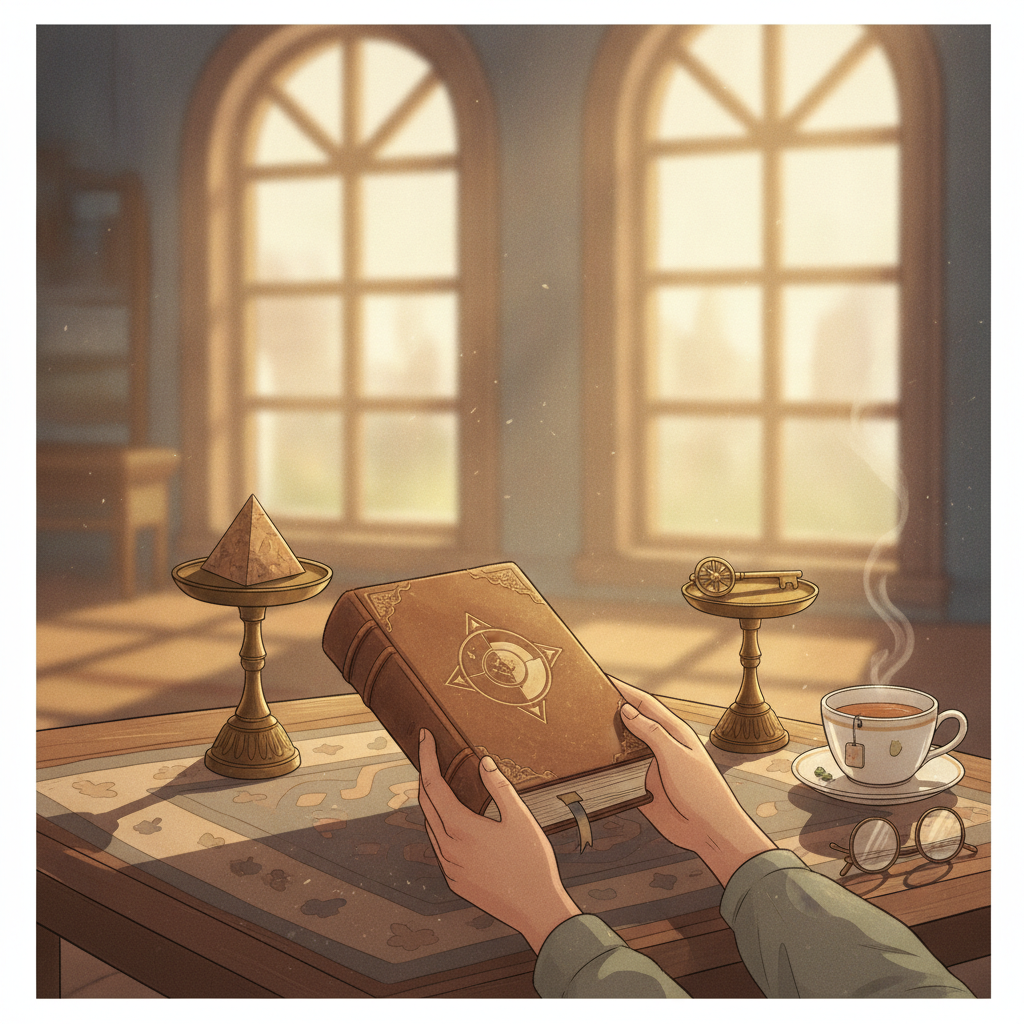
The warrior of light studies the two columns on either side of the door he is trying to open. One is called Fear and the other is called Desire. Fear warns of a dangerous unfamiliar world where everything learned proves useless. Desire promises what awaits on the other side. Neither column mentions what happens after the door opens, and neither mentions the ten thousand small decisions that actually build the thing. That omission is the subject of this piece: everybody talks about the columns, and the ten thousand decisions determine whether anything gets built at all.
Every origin story needs a reason to walk through the door. Santiago’s personal legend in The Alchemist is a clean narrative engine: the universe conspires to help you achieve what your heart truly wants. It moves a shepherd boy across a desert, and it moves a lot of people out of jobs they had outgrown, which is not nothing. It is also, practically speaking, the story you tell yourself before you understand what the work actually is. The engine is real. It is just an ignition system, and an ignition system that keeps firing after the engine has started is a malfunction.
The work is not pursuit. The work is breadth.
Why the Door Is Not the Story
A voice in the reading stack has been saying this for years, quietly, in the middle of management advice that mostly gets ignored. Open your mind and broaden your scope of knowledge. Creativity emerges from breadth, not depth, from pulling ideas out of arenas brand new to you and translating them into your own sphere of interest. The useful thing is the subconscious novel connection that sneaks in while you are dealing with a thorny issue in a completely different domain, the solution that arrives sideways because your attention was elsewhere. This is not mechanical, and it cannot be scheduled. It is the mind operating as it actually operates, which is to say associatively rather than linearly, assembling an answer out of materials you did not know you were collecting.
That is precisely what the door narrative cannot account for. Fear and Desire are both stories about a single moment: the threshold, the decision, the before and the after. They are dramatic because moments are dramatic. But the associative work that produces anything worth having is diffuse by nature. It happens across years and across domains, and it never resolves into a scene. Nobody writes a parable about the afternoon you finally understood why a logistics problem and a scheduling problem were the same problem. There is no column at the door for that.
Breadth Beats Depth
Consider the iPhone. The most successful product of the mobile era started as one thing, became another, then another. The history is not a straight line of vision, whatever the retellings suggest. It is a series of adaptations: to bandwidth, to carrier deals, to an app economy that nobody predicted and that was not part of the original plan, to the shift from communication device to primary computing surface to the center of an ecosystem that now includes watches, rings, and headphones. Each of those turns required absorbing a constraint or an opportunity that the founding story had no room for. The product became successful not because the original story was right. It became successful because the team behind it kept taking in new information without insisting the thing remain true to its founding myth.
Or consider the deals that do not work, which teach the same lesson from the other side. An acquisition from 1984 that history barely mentions: IBM bought a company and afterward concluded there was nothing in its pool of resources that justified the price. The narrative that motivated the purchase had nothing to do with what the company actually contained. Somebody had a clean story about strategic fit, the story was internally coherent, and the coherence was the problem. A story tight enough to win an argument is tight enough to exclude the evidence that would have stopped it. The story preceded the substance, and the story lost.
The same pattern repeats everywhere once you start looking for it. Startups founded on a compelling origin myth that never makes money. Investment theses so clean they cannot survive contact with a market that refuses to hold still. Product roadmaps built around what the team wants to build rather than what users are actually trying to do. In each case the failure is not a lack of conviction. It is a surplus of it, applied to a narrative that stopped describing reality some time ago. The desire column is always more attractive than the fear column, but the door opens onto neither. It opens onto a workshop.
What the iPhone Actually Did
There is a quiet humility in admitting that the thing that got you started is not the thing that sustains you. The personal legend is the spark, not the fuel. The two columns at the door are theater, well built and satisfying to look at, and theater is not architecture. The real architecture is whatever you build after you stop performing the story of why you walked through, and it tends to be made of unglamorous material: the second version of a plan, the constraint you accepted, the feature you cut because the evidence said so.
Breadth is not a lack of focus, which is the objection that always comes next. It is the substrate of the connections that make focused execution actually matter. You cannot connect ideas you never let in, and you cannot adapt to shifts you never saw coming because you were too busy staying pure. Depth without breadth produces people who are excellent at answering a question nobody is asking anymore. The specialist who reads only the specialty is not more focused than the generalist. They are simply focused on a smaller set of inputs, which feels like discipline right up until the moment the relevant input comes from outside the set.
The uncomfortable read is this: most of the advice world sells the door, not the workshop. The chase, not the craft. The transformation narrative, not the Tuesday afternoon where you realize the project needs to pivot because the world changed while you were sleeping in. That pivot is unphotogenic and slightly humiliating, and it is where the actual work happens. It is also where breadth earns its keep, because a pivot is only available to someone who has already, half accidentally, stocked their head with somewhere else to go.
The Workshop After the Door
The iPhone, the company that absorbed it into a larger ecosystem, the product that outlived its own category: none of them survived by being right the first time. They survived by letting the original story die and being willing to replace it with whatever the evidence required, repeatedly, without treating each replacement as a betrayal of the founding vision. That willingness is rarer than talent and much rarer than conviction, and it is the closest thing to a common factor across the things that last.
So the columns are worth studying, once. Fear is honest about what you are risking, and Desire is honest about why you would risk it. Neither is equipped to tell you anything about the decade after, which is the part you are actually signing up for. Personal legend is a fine place to start. It is a terrible place to stay. The work is what comes after the story breaks, and the people who do it well are the ones who stopped needing the story to be true.
Leave a Reply