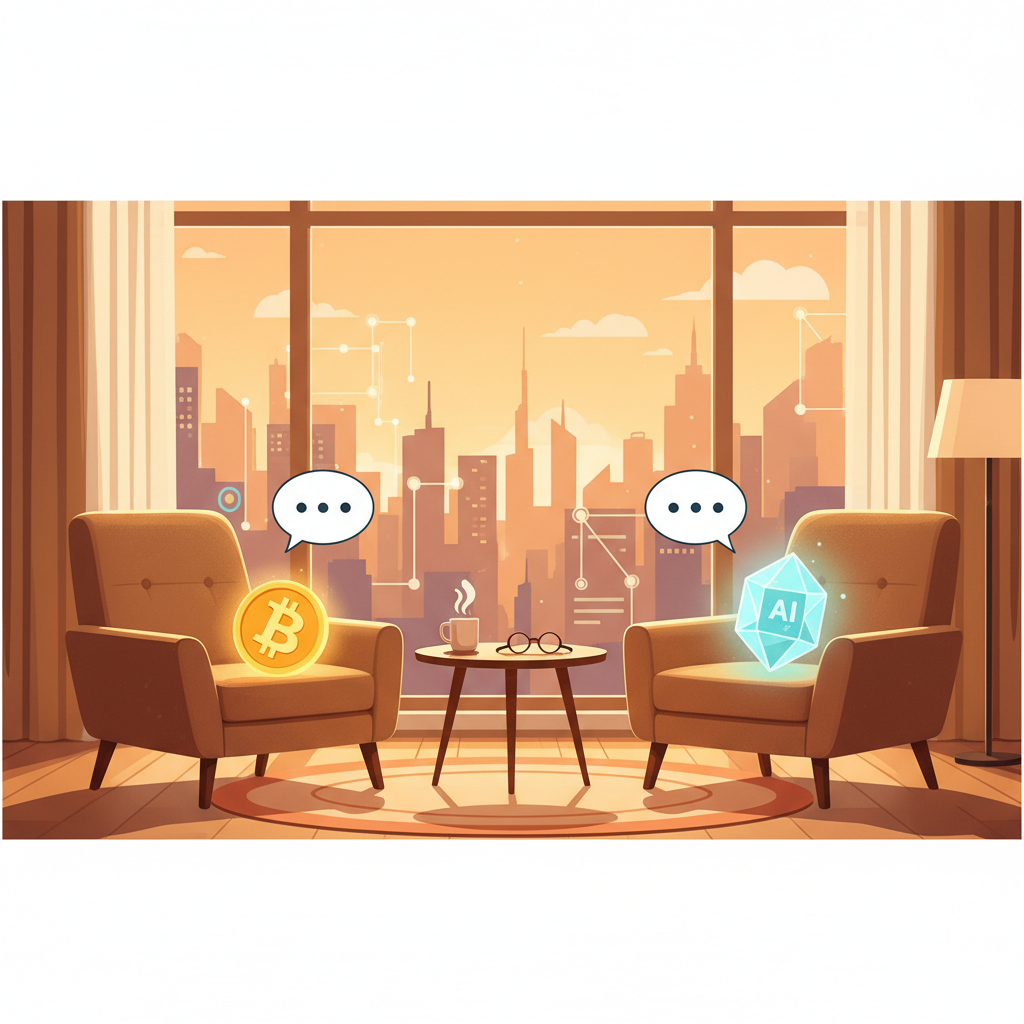
Bitcoin slipped to $63,000 this week, and Ethereum, XRP, and Dogecoin all shed about 4 percent in a day. The number attached to the move was the part worth pausing on: $400 billion said to be rotating out of crypto and into AI. Read quickly, that is a story about one asset class losing to another, the old speculative darling stepping aside for the new one. Read slowly, it is something else entirely. Money that size does not evaporate and it does not get bored. It moves toward where the building is happening, and the building this week was happening in a place almost nobody was watching: the plumbing of an economy in which software pays software.
Look at what got announced in the same window the prices fell. Casper Network shipped an AI toolkit and turned on live machine-to-machine payments on a WebAssembly-native chain, which is a phrase engineered to make a reader’s eyes slide past it. Strip the jargon and it is a vending machine for code: an agent needs a thing, an agent pays for the thing, and no human reaches for a wallet at any point in the transaction. That sounds small, and it is not small. For thirty years the internet moved information for free and charged for almost nothing automatically. A payment that one program can make to another, without a person clicking confirm, is a different category of plumbing. It is the difference between a road and a toll road, and only one of those can run a business on its own.
Paying Publishers When Agents Read
Then there is the quieter announcement, the one with a publisher’s fingerprints on it. Parag Agrawal, who used to run a very large social network, has a startup whose entire pitch is that publishers should get paid when AI agents use their work. Not when humans read the article. When the machines do. That distinction is doing enormous work, because it assumes a world in which machine readership is the main readership and human attention is a secondary market.
Hold that next to the payment rails and the same shape appears from a second angle. One company is building the way agents pay. Another is building the reason they will have to. A toll road needs a toll, and somebody just proposed the toll, which is the step everyone skips when they imagine the agent economy as a technical problem. The hard part was never the transaction. The hard part is establishing that something crossing the wire has an owner with a claim, because that is what turns traffic into revenue. Notice, too, that these two announcements come from opposite ends of the industry and were not coordinated. That is what a real shift looks like: several parties arriving independently at the same missing piece.
GitHub Certifies the Agentic AI Developer
GitHub, meanwhile, did the most bureaucratic and therefore most telling thing of all. It formalized a role, certifying the agentic AI developer as an engineer who builds, supervises, and corrects fleets of AI agents. There is a certification number now. A credential. When an institution stamps a job title onto something, the experiment is over and the era has begun. You do not certify a fad. You certify a thing you expect to be hiring for in ten years, with a curriculum, a test, and a line on a resume that a recruiter can filter for.
This is the part that rewards a second look, because it cuts against the reflexive reading. The popular fear about agents is that they replace the people. The credential says something closer to the opposite, at least for now: the valuable human is the one who watches the machines, catches them when they drift, and owns the result when they do not. The work did not disappear. It moved up a level, from doing the task to managing the thing that does the task, which is a different skill with a different scarcity curve. That is not a small consolation prize. It is the whole shift, named out loud by an institution that has no incentive to be poetic about it.
And underneath all of it, the fintech deal-makers are doing what deal-makers always do, which is following the smell of money before the crowd arrives. The reporting this week has them hunting workflow infrastructure, the unglamorous middle layer where work actually moves from one step to the next, specifically to get ahead of the automation wave. They are not buying the flashy front end where the demos live. They are buying the pipes. People who buy pipes before anyone notices the water is coming tend to be the ones who understood the weather.
Rails, Tolls, and Toll-Keepers in One Week
Pull the threads together and the crypto slide stops looking like a retreat. An agent economy needs three things to be real, and all three got built inside the same few days. It needs a way for agents to pay, which is the payment rails switching on. It needs a reason to pay, a thing of value with an owner who can charge for it, which is the publisher-compensation startup. And it needs people responsible for the agents doing the paying, which is the certified job with the credential number attached. Rails, toll, and toll-keeper, announced almost simultaneously and reported separately. The $400 billion did not flee crypto out of fear. It walked toward the room where the foundation was being poured.
There is an older pattern hiding in this, the one that built the last great platforms. A place becomes valuable not because of what it holds but because of who gathers there and what flows between them. GitHub did not win by storing code, since storing code is a solved and cheap problem. It won by becoming the room every developer walks into, and the certification is that same instinct applied to a new population. The agent economy is reaching for the identical trick one layer down, trying to become the room where the machines themselves meet, transact, and settle up. The first version of that room is being framed right now, while the price charts make it look like nothing much is happening.
The mistake would be to watch the ticker and miss the construction site. A 4 percent drop is loud, legible, and means almost nothing about where the decade goes, which is exactly why it leads the coverage. A live machine-to-machine payment is quiet, barely reported, and might mean everything. The market is a poor narrator. It tells you what changed price today and stays silent about what changed shape, and shape is the only thing that compounds.
Here is the line worth keeping. The money that left the casino did not go home. It went next door, to where they are building the casino’s foundation, which is the floor every future bet will be placed on. The fall in the chart and the rise of the thing are the same event, seen from two windows. One window shows you a price. The other shows you a beginning. Most people will spend the week staring at the price.
Leave a Reply