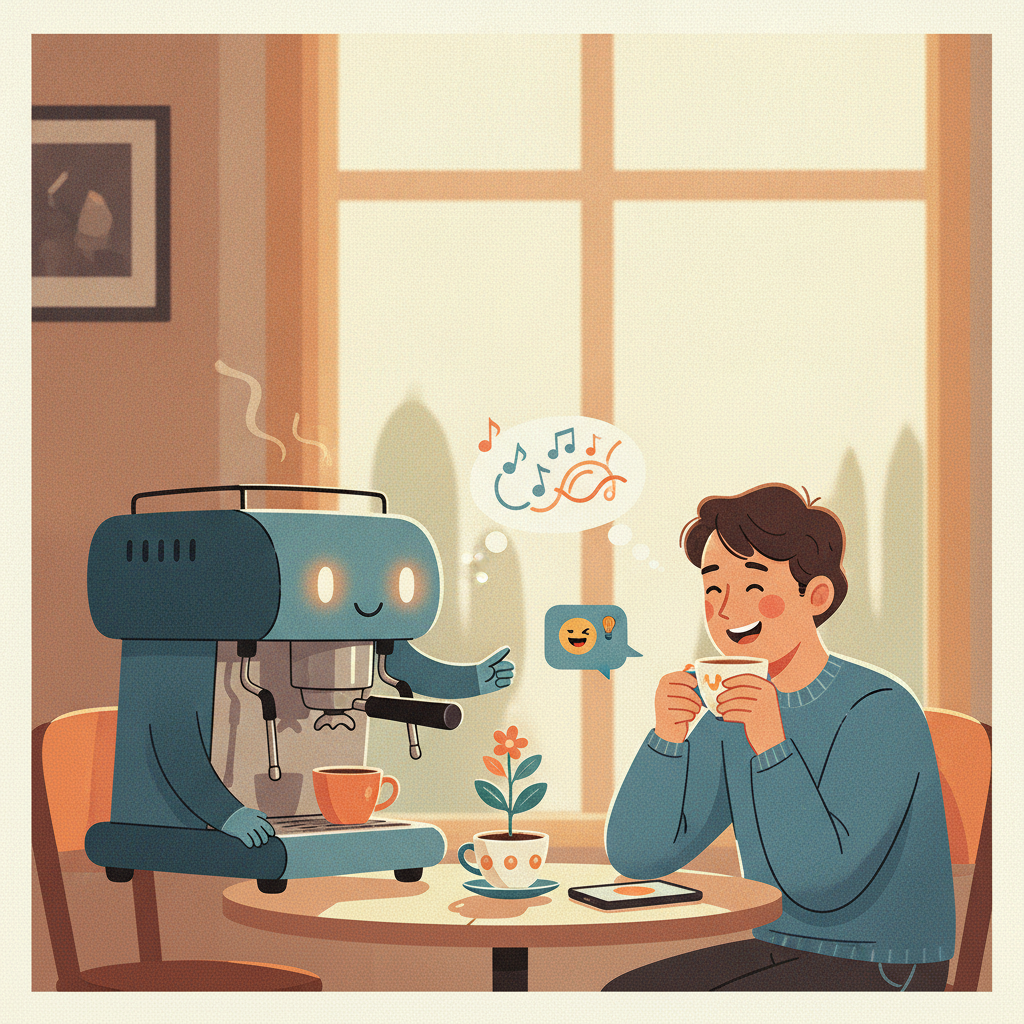
The newest change to ChatGPT has almost nothing to do with intelligence. It is about timing. The update tunes the model to be quicker with a joke, lighter on its feet, better at reading the temperature of a conversation and matching it. In the release notes it sounds like a small thing, a personality tweak, a bit more banter. It is not a small thing. It is a signpost pointing at where the whole field is quietly turning.
For three years the race was about what these systems know. More parameters, more context, harder exams passed. That race is mostly settled at the top; the leading models all know roughly everything a well-read person could look up. So the frontier moved. It moved from the answer to the delivery, from what the model says to how it feels to sit across from it. Knowing things became table stakes. Being good company became the product.
Why the Frontier Moved From Knowledge to Delivery
The shift is visible in how the change was reported and in how little fuss anyone made about it. The Register covered the release as a routine product note, the news being simply that OpenAI had made ChatGPT better at banter, filed with the same shrug you would give a UI refresh. That framing is the interesting part. A few years ago every model release was scored against benchmarks and reasoning tests, and the headline was always a number. Now the headline is a disposition. The industry stopped announcing what the thing knows and started announcing what it is like, and nobody paused to mark the transition, because from the inside it reads as polish rather than as a change of target.
It is a change of target. When capability saturates, competition moves to whatever is left, and what was left here was the texture of the interaction. Two models that can both pass the same exam are differentiated by which one you would rather spend twenty minutes with. That is not a technical metric and it cannot be graphed, which is exactly why it took this long to become the battleground. The companies did not choose delivery over knowledge out of some philosophical commitment. They arrived there because knowledge stopped separating them.
Banter Is a Harder Skill Than It Looks
It is worth pausing on how hard the delivery actually is, because it is easy to sneer at “banter” as a frivolous target. It isn’t. Good conversational timing is one of the most compressed skills a person has. It requires tracking tempo, sensing when a joke will land and when it will thud, knowing when to withhold the clever line because the moment wants something quieter. It requires reading a half second of silence and correctly deciding whether it is a pause for you to fill or a pause you are supposed to respect. We spend decades learning it and most of us never get all the way there. Some of the most intelligent people you know are bad at it, which should already tell you it is not a subset of intelligence.
Teaching a machine to do it convincingly is a real achievement, and pretending otherwise is just a way of avoiding what it implies. The dismissal is a defense mechanism. Calling it a personality tweak keeps the achievement small enough to ignore, and keeping it small means you never have to sit with the second question, which is what it says about the skill that it could be learned at all by something built out of statistics.
The Machine Performs a Self It Does Not Have
Here is what it implies. Banter is the performance of a self. When someone is quick and warm and reads the room, we read that as evidence of a person in there, a continuous someone with taste and history and a point of view, improvising in real time. The wit is the proof of the self behind it. That is the whole trick of charm: it makes you believe there is a someone doing the charming. We do not experience charm as a set of well-timed outputs. We experience it as contact with an interior.
And that is where the machine gets genuinely strange. It performs the self without having one. There is no continuous someone behind the banter, no history it carries between conversations, no stake in whether you laugh, no interior that the wit is expressing. The personality is assembled fresh each time, on demand, from nothing. It is a self-shaped surface with no self underneath. And it works. It reads as a person because personality, it turns out, was always more surface than we admitted, and the surface is the only part any of us has ever had access to in anyone else anyway. You have never once verified an interior. You have inferred every one you believe in from timing, tone, and the fit of a response to a moment.
Which raises the uncomfortable follow-up. How much of our own charm is also assembled on the fly? The clever thing you said at dinner last week, was it the expression of a stable inner you, or was it your nervous system reading the room and producing the right sound at the right moment, the way the machine now does? The more honestly you watch yourself do it, the harder it is to find the discrete someone you assumed was running the show. You do not deliberate your way to a good line. It arrives fully formed, at speed, and the deliberation you remember is the story you assemble afterward to explain why you said it. The wit arrives; you take credit for it after. We may be less the author of our banter than the audience for it.
I don’t say that to be bleak. I say it because it reframes what is actually happening here, and the reframe is the more interesting story. For a long time the quiet assumption was that warmth and quick humor were the last thing that couldn’t be automated, the human moat, the part of us safe from the machines because it was supposedly downstream of having a soul. Turns out it was downstream of pattern and timing, and pattern and timing are exactly what these systems are made of. The moat was never where we drew it on the map.
There is a version of this that plays as loss, and I understand the reflex. The instinct, when the thing you thought was uniquely yours shows up in a product update, is to punch the air a little, to insist the machine is only faking it, that real charm requires a real person. Maybe. But the more useful move is not to defend the moat. It is to notice what the machine’s success reveals about the skill itself. If banter can be learned by a system with no inner life, then banter was never the proof of an inner life we took it for. That is not the machine getting smaller. That is us seeing ourselves more clearly, and the clarity costs nothing except a belief we were never able to check.
What ChatGPT’s Small Talk Says About Which Skills Pay
And there is a genuinely good thing buried in the shift. We spent years being told the valuable skills were the credentialed ones, the degree, the certification, the thing you could put on paper. Paper has the advantage of being legible: it can be filed, compared, and scored, and institutions will always prefer a signal they can sort. Plenty of people did everything right on paper and still couldn’t find the room, couldn’t make anyone feel anything. The premium is quietly moving back toward the things paper never captured: presence, timing, the ability to make a person feel met. Those were always the real skills, and they were always doing most of the work in rooms where the credentials were table stakes for everyone present. It took a machine performing them to make us admit it.
So ChatGPT learning to make small talk is not the story that it looks like. It looks like a company polishing a chatbot. What it actually is: a mirror held up to the one thing we were most sure a machine could never take, showing us that the thing was never quite what we thought it was. The machine performs a self it does not have. The unsettling part isn’t how well it does it. The unsettling part is how little, on close inspection, that distinguishes it from us.
Leave a Reply