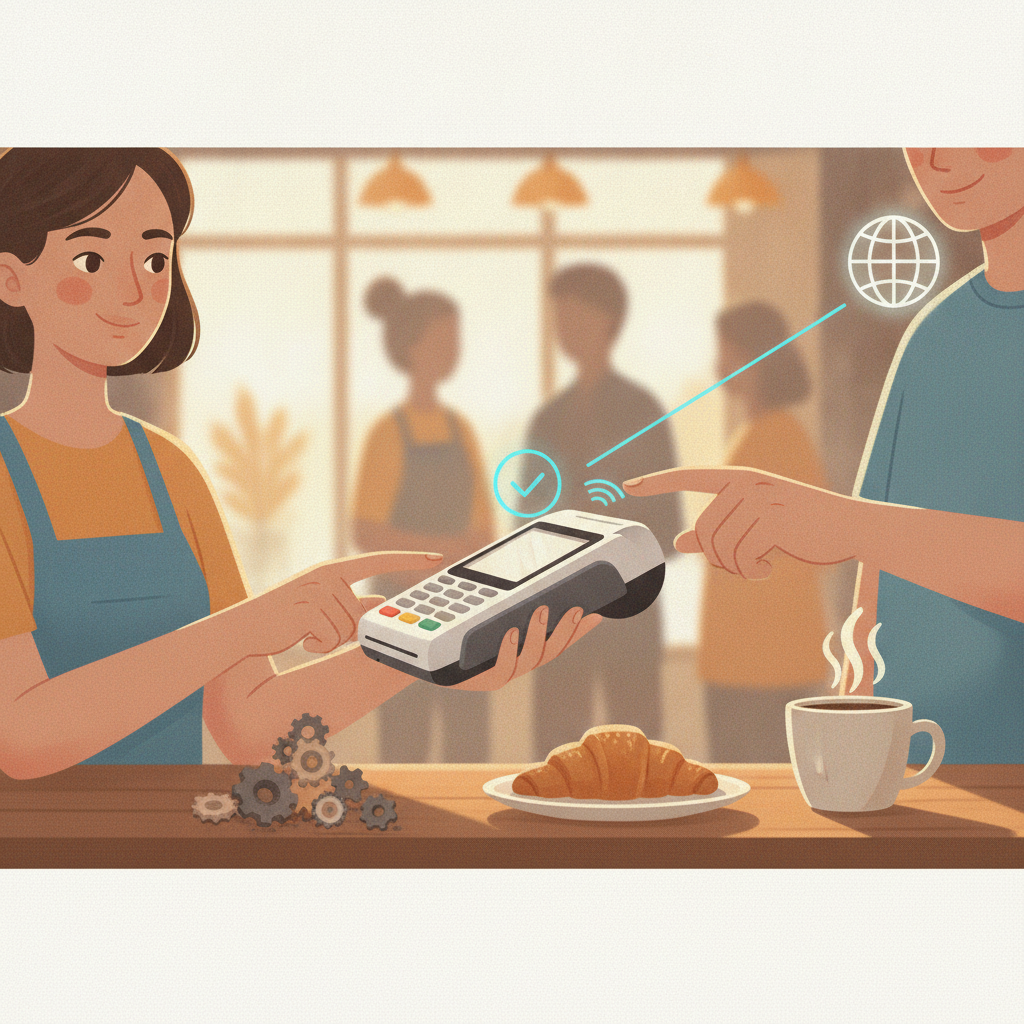
A shop owner swaps a clunky cash register for one that takes a tap. Cards, phone wallets, the whole thing set up before lunch with no technician and no training day. The line moves faster, the owner stops thinking about the machine entirely, and customers pay whichever way they already prefer. That is the whole pitch, and it is a good one. Nothing about it is a trick.
What the owner did not buy, and could not have bought, is the disappearance of the rails. Money still travels through someone else’s pipes, under someone else’s rules, with someone else’s cut taken at the speed of a swipe. The friction went to zero in the one place it was visible, which happens to be the only place anyone was looking. The friction itself did not go anywhere. It moved, and it kept its teeth. That is the pattern worth naming, because once you see it in a card reader you start seeing it in almost everything built in the last two decades: when friction leaves your field of view, it has relocated, not retired.
Where the Payment Rails Keep Their Fee
The payment networks figured this out first and charged everyone for the lesson. The money was never in the card, which is just a token, and it was never really in the terminal either. It sits in the rails that everyone rents and then rebrands as their own: the settlement, the ledger, the license to move value and keep a sliver for the trouble. The economics of that position are unusually durable, because the rail does not have to win any customers. It only has to be underneath them.
A facilitator wraps those rails in a clean box so the owner never meets them, never learns their vocabulary, and never has to negotiate anything. The owner feels free, and in the ways that show up during a lunch rush, the owner genuinely is. The rail feels nothing and keeps its fee. Both things are true at once, and the interesting question is not whether the arrangement is fair but how completely the box hides that an arrangement exists at all.
A Clean Interface Is a Curtain, Not a Clearing
That is the quiet structure underneath most of what got built recently. We mistake the removal of friction from our field of view for the removal of constraint from the world. The interface got clean. The forces underneath did not get weaker; they got hidden, which is the worse outcome, because a hidden force still acts and now you cannot see it coming. The clean screen is a curtain, not a clearing, and the difference only becomes obvious on the day something behind it fails.
The habit generalizes further than commerce. We beam documents across the planet in nanoseconds and read faces in high definition from the opposite side of it. After enough of that, it is easy to believe the world has been domesticated, that nature has finally agreed to submit to whim and schedule. It hasn’t. The storm still arrives on its own clock and consults nobody. The body still quits without asking permission or giving notice. Generations that lived nearer to that fact kept a word for it and reached for it often; we retired the word, because saying it out loud would interrupt the feeling that we are the ones in charge here.
The assumption is harmless in a video call and expensive in a portfolio. The same reflex that trusts the tap also trusts the trend that just broke, for the same reason: both have been reliable, neither has been examined, and the examination has no obvious payoff until it has an enormous one.
What the Memory Tools Relocate
The tools that remember for us run an identical sleight of hand, and they are worth looking at precisely because they are so clearly good. A reader saves a passage and a system feeds it back on a timed schedule so the forgetting never quite takes. That is genuinely useful. It works. It does something the unaided mind cannot do at that scale.
What happened underneath is that the cost of lost memory relocated. It left the reader’s own head and landed on a subscription and a sync, paid monthly, maintained by other people, dependent on a company continuing to exist. The reader is now freer to read more and remember less, which is an honest trade rather than a scandal. It is only a problem if nobody notices it was a trade. Put the register and the recall system side by side and the friction reads the same way in both: it did not vanish, it changed address, and the new address is somewhere you do not control and cannot inspect.
None of this is nostalgia, and nothing here argues for the clunky register. The register is better. The recall system is better. The call is better. The point is narrower and more useful than a complaint: the moment friction leaves your sight, assume it relocated, then go find where it landed and who is carrying it now. That is a question with an answer, and the answer is usually specific.
The writers of an earlier age, the ones who bent language until it held weight, understood something about resistance that the frictionless age forgot how to say. Not that difficulty is virtuous in itself, which is the cheap version of the idea and the one most often sold. What they understood is that meaning gets earned against something that pushes back, and when you delete the pushback you also delete the earning. A tool that removes the work can quietly remove the reason the work was worth doing. The app that writes the poem for you also writes away the reason you needed to.
Friction in the Right Place
Here is the part that sounds like a contradiction and is not. The freest move on the board is usually to accept the law you cannot break and then build on top of it. The owner who stops fighting the rails and redesigns the whole counter around the tap will out-earn the one who spends the year resenting the cut. The reader who admits the forgetting will happen without help builds the help, and stops pretending their memory is bottomless. Acceptance in that sense is not surrender; it is the only ground solid enough to stand on and make something that lasts. Fighting a constraint you cannot move is just paying the constraint twice.
Which means the finish line was never zero friction everywhere, though we keep building as though it were, as though the perfect product is the one you never feel yourself using. The better target is friction in the right place. Let the payment clear without a thought, and spend the thinking on what the payment was for. Let the app hold the date, and keep the attention for what the date meant. Move the weight on purpose, or it moves without you and sends the bill later, usually stamped with a date you have already forgotten.
The rail under the tap is not going away. The schedule that returns your own highlights to you is not going away. The world that does not consult you before it turns is not going away, and it never agreed to. The work is not to make any of them invisible, because invisible is the state in which they cost the most. The work is to choose, while you still can, where the weight lands once it leaves your hands, and to stop confusing a clean surface with an absent floor.
Leave a Reply