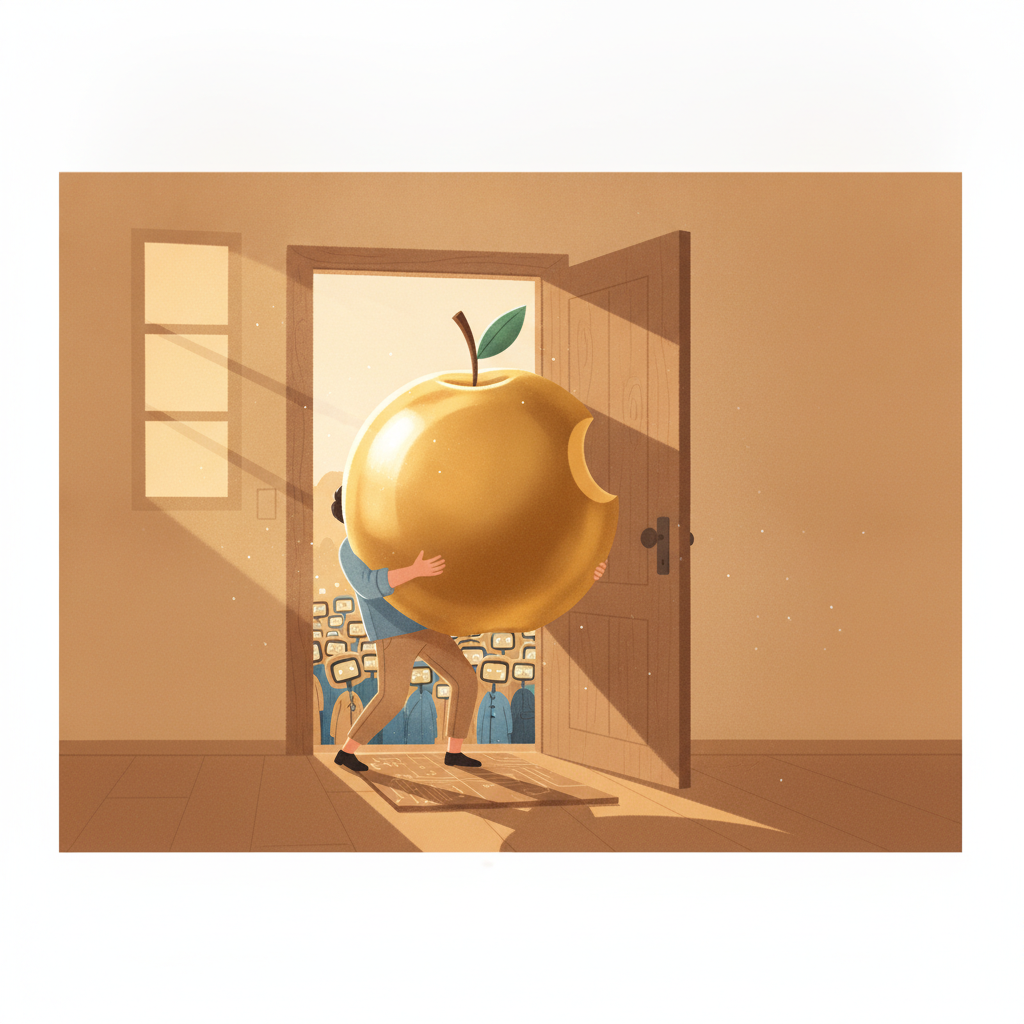
A space-and-AI conglomerate priced its public debut at $135 a share today, and the number is almost the least interesting thing about it. What is actually being sold is a position: ownership of a surface people already look up at. That is the quiet logic running through almost everything worth noticing today, and it is worth saying plainly before the examples pile up. The engine is becoming a component. The doorway in front of it is becoming the asset. Hardware and models are the easy parts to admire and the hard parts to defend, and the companies with the most to lose have already figured that out.
Start with the split forming in artificial intelligence, because it is the cleanest version of the pattern. CNBC’s read on the market is that OpenAI is leaning hard into selling to businesses, while Apple and Google, the two companies that already sit in a billion pockets, aim their AI squarely at ordinary people. On the surface that looks like a straightforward strategy difference, the kind of segmentation any analyst would sketch on a whiteboard. Underneath, it is an admission about where defensible ground actually sits. If you already control the phone in the hand and the search box people reach for without thinking, you do not need to win the race to build the smartest engine. You just need to be the door that engine’s output walks through. And if you do not control that door, enterprise contracts are a perfectly rational place to go, because a purchase order is the closest thing to a doorway you can buy when you were not born standing in one.
Google Search Stops Sending You to the Shelf
You could see the same move in a sharper form in real estate, where Google announced that home listings will now appear directly inside its results across the country. Barron’s framed it as a competitive problem for the listing companies, which it plainly is, but the structural change is bigger than any one quarter of anyone’s stock. For years a search was a hallway. You typed a question and got pointed somewhere else, to the listing site, the broker, or the marketplace that actually held the goods. The hallway was neutral by design, and the businesses at the far end of it grew enormous on the assumption that neutrality was permanent. Now the hallway is becoming the room. The companies that used to receive that traffic are about to learn what it means to be a supplier instead of a destination, which is a very different business with very different margins and almost no leverage.
That reframing is worth sitting with, because it generalizes past housing. Somewhere on every platform, units of value get made, and somewhere else a filter decides which of them reaches you. We spend almost all our attention on the making. We spend almost none on the filter. The power has been pooling in the filter this whole time, quietly, without anyone needing to announce it, because in a world drowning in supply the scarce thing is not production. It is relevance. A listing that nobody surfaces is not a listing; it is a row in a database. The moment the surface that decides what gets seen also decides to hold the inventory, the people who own the inventory discover they were renting their own customers all along.
Microsoft Freezes the Model and Upgrades the Wrapper
Microsoft put out something this week that names this directly, even if it did not mean to. VentureBeat covered a tool that upgrades an AI agent’s skills without touching the model’s weights, which sounds like a narrow engineering convenience until you read it twice. The intelligence in the box stays frozen, and the useful improvement happens in a layer wrapped around it. The expensive, celebrated core, the weights everyone raised billions of dollars to train, is now treated as a fixed component you route around rather than a thing you rebuild. Do not touch the engine. Improve the doorway.
Set that next to the enterprise-versus-consumer split and the friction between the two stories tells you something neither says alone. One story is about who gets to stand closest to the customer. The other is about the engineering world quietly concluding that the part everyone stands closest to is not the model at all. When the tooling starts optimizing the wrapper instead of the weights, the industry has already priced the weights as infrastructure, whatever the funding announcements still say. That is what a commodity looks like in its early, well-funded, still-glamorous phase.
Even the money plumbing told the same story from another angle. Bitget Wallet launched what it calls a payments layer stitching together banks, card networks, and blockchains, and the notable thing is what it declines to attempt. It is not trying to replace any of those rails. It wants to be the connective tissue that lets value pass between them, which is a smaller ambition on paper and a larger one in practice. Nobody falls in love with the payment box. They fall in love with not having to think about which rail the money rides, and the company that removes the thinking gets to sit between the customer and every rail underneath.
The Model Was Always Going to Be a Component
There is a piece of recent history worth holding next to all of this. The most important consumer product of the last twenty years did not start out built from its maker’s own parts. Its first brains came from a rival, and its early graphics came from outside suppliers. Those parts got commoditized on schedule, absorbed, second-sourced, and eventually replaced by cheaper equivalents nobody wrote headlines about. The doorway never did. The thing that survived was not any component in the device, but the position the device occupied in a person’s day.
We are watching that sorting happen again in fast-forward, compressed from a decade into a news cycle. Models will get cheaper, more interchangeable, and more boring, exactly the way every miracle component eventually does once enough capital chases it. What will not commoditize is the last inch before a human being: the search box, the phone, the wallet that hides the rails, and the skill layer that decides what the frozen engine actually does with a request. Each of those is unglamorous. Each of them is also the only place where a preference gets formed and a habit gets kept.
The tell is where the serious players stopped competing. They stopped trying to own the smartest thing in the room, and started fighting over the doorway you have to walk through to reach it. That is why a listings feature inside a search page matters more than another benchmark, and why a tool for upgrading skills around a frozen model matters more than the model’s next version number. The model was never the moat. The moat is whoever stands where you already are.
Leave a Reply