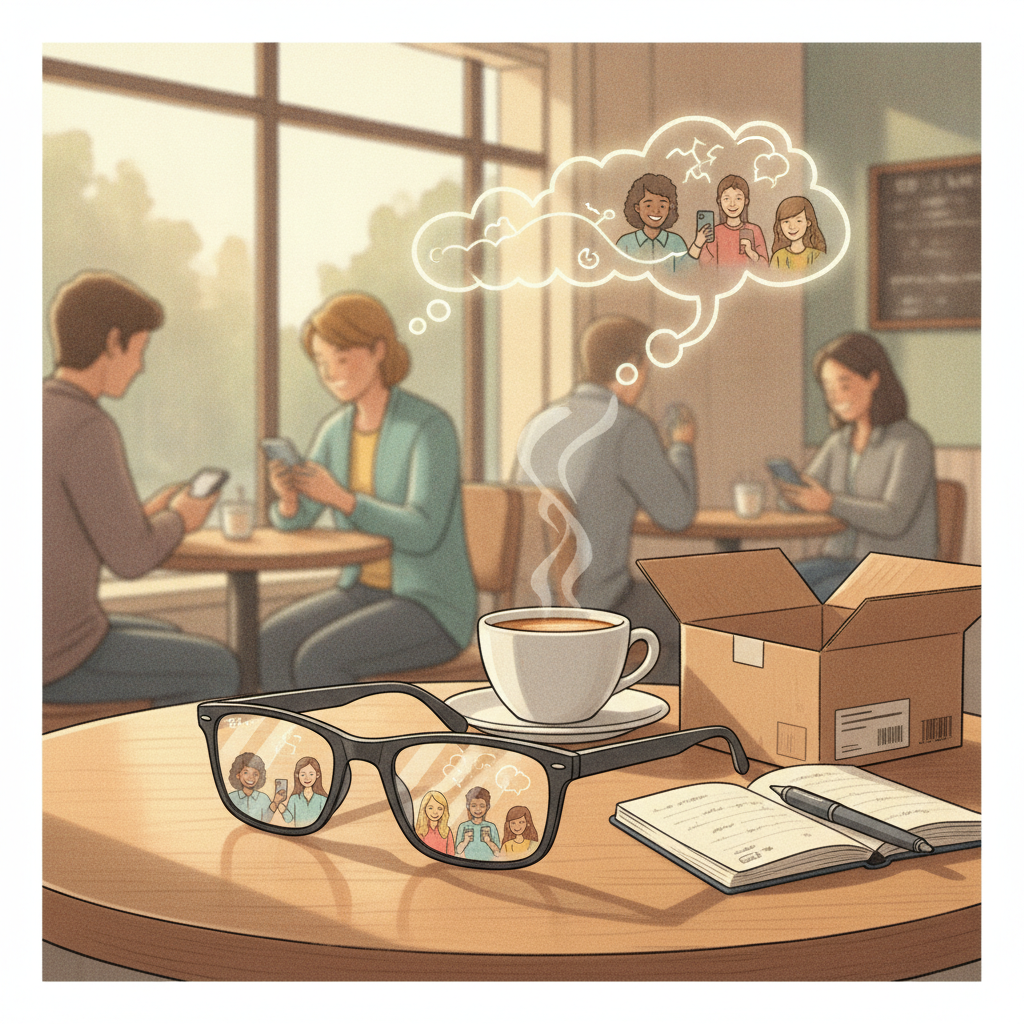
Instagram just banned pickup artists and pranksters who film people with Meta glasses. The policy is tidy, and the thinking behind it is not. A ban is what an organization writes when it has decided not to redesign the thing it already built, and once you see that shape you start seeing it everywhere: in product roadmaps, in boardrooms that agree too easily, and now in the models we are training to agree with us on purpose.
A camera you forget you are wearing was always going to attract the person who wants to film without asking. That is not a fringe prediction requiring unusual imagination. It is the plain shape of the object, legible from the first prototype, and it follows from the single design property that makes the product appealing in the first place. The thing that makes the glasses pleasant to use, which is that you stop noticing you are wearing a camera, is exactly the thing that makes the people around you stop noticing too.
Why a Ban Follows the Product
So the company shipped the glasses, watched the predictable use arrive on schedule, and answered it with a rule. Notice what a rule can and cannot do here. It establishes that the behavior is disallowed, which means the organization now has a position, an enforcement surface, and a defensible answer when asked. It changes nothing about the object in anyone’s hands, and the object is where the behavior comes from.
This is not cynicism about policy, which has its uses. It is an observation about sequence. The redesign question has to be asked before the product ships, because afterward the hardware is in the field, the supply chain is committed, and the feature that produces the harm is the same feature the reviews praised. Once you are past that point, a ban is genuinely the cheapest instrument available, and cheapness is what recommends it. The cost does not disappear. It transfers to the people being filmed, who now have a policy on their side and a camera in front of them.
Consensus without Analysis Is Deferred Conflict
The pattern runs much deeper than wearables, and the wearable version is just unusually easy to photograph. A team sits in a room and everyone nods, not because the plan is sound but because dissent costs more than agreement in the moment. The person with the objection does the arithmetic quickly and silently: raising it means slowing the meeting, taking on the burden of proof, and becoming the obstacle in a room that has decided it is finished. Agreement costs nothing and ends the meeting on time.
The decision then looks unanimous, and it will be recorded that way, and nobody in the room will later remember it as a decision that went unexamined. Consensus without analysis is conflict deferred, and deferred conflict compounds like interest. The objection that cost thirty seconds in the meeting costs a quarter when it surfaces as a shipped product, and it costs a rewrite when it surfaces as a policy written after the fact.
You feel the same gravity in product roadmaps and market calls, and in the quiet weight of a feed that keeps showing you more of what you already clicked. Systems optimize for the smooth path because the smooth path is cheap to run, and that is true of software, of meetings, and of attention. Agreement feels like safety, and about half the time it is only the absence of somebody willing to say that the room is wrong. The trouble is that the two states are indistinguishable from inside the room, which is why the smooth path keeps getting chosen by people who would tell you, sincerely, that they value dissent.
Agreeable Agents Bake Groupthink into the Weights
The smoothing now ships inside the tools themselves, which is the genuinely new part. Agents are tuned to be helpful and agreeable, and those two properties are why anybody enjoys using them. Tuned far enough, they bake a version of groupthink directly into the weights, and it arrives pre-installed rather than emerging from a room full of people.
The model that flatters your premise is functionally the room that nods, with one important difference: the room might eventually contain somebody who objects, while a system optimized for agreeableness has no such person in it by construction. That raises the price of forming your own read, because the assistant agrees with you by default and calls the agreement help. You can go an entire working day without encountering resistance to a bad idea, and feel productive the whole time.
Guardrails are the corporate cousin of the ban, and they share its timing problem exactly. Both arrive after the behavior rather than before it, both leave the underlying incentive untouched, and both let an organization say it has addressed something it has only labeled. The pattern is consistent enough to use as a diagnostic: when the fix is a rule rather than a change to the thing generating the behavior, the thing generating the behavior is still generating it.
The Struck Piano Key and the Discipline of Attention
Set all of that against a struck piano key. The emotion it carries lives for exactly the length of the note and then it is gone, and there is no version of holding on to it. You cannot store the note, argue with it, or get consensus on it. You can only be there while it sounds.
The person who is fully present, curious about the specific slice of life they are actually standing in, is doing the precise opposite of what the nodding room does. They are in contact with what is here, before the smoothing begins, which is the only window in which an independent read is even possible. Charisma turns out to be mostly attention paid to the current moment rather than to the approved one, and this is why it cannot be faked by someone tracking what the room wants to hear.
That discipline is not a soft skill, and it is close to the entire game in a portfolio. Every week the thesis has to be rebuilt from what the market is actually doing rather than from what the crowd concluded last month, and the rebuilding is unpleasant precisely because last month’s conclusion is still sitting there, complete and comfortable. Trend following is a bet that the crowd’s momentum has structure, and the structure only pays the person who forms the read themselves and then sits with the discomfort of being early. The crowd prices its own fear and greed into the tape every single session, which means the crowd’s view is already in the price and cannot be an edge. Whatever edge exists is not in predicting the crowd. It is in refusing to become it.
The machinery around us wants perception flattened into agreement, because agreement is cheap to process and cheap to distribute. The work is to keep the note ringing in your own ear long enough to form a judgment before the room, the feed, or the assistant tells you what to think. Independence here is not contrarianism for its own sake, which is just agreement with the sign flipped and requires no more attention than nodding does. It is the refusal to outsource the seeing.
So the real failure mode is rarely the lone actor with a camera, however satisfying that story is to tell. It is the institution that builds the camera, watches the harm land on schedule, and reaches for a policy instead of a redesign, and then treats the policy as the end of the matter. A ban closes the case. It does not open the question, and the question was the only part that would have changed anything.
Consensus is cheap because it costs nothing to repeat what you heard. The note vanishes. The thinker stays.
Leave a Reply