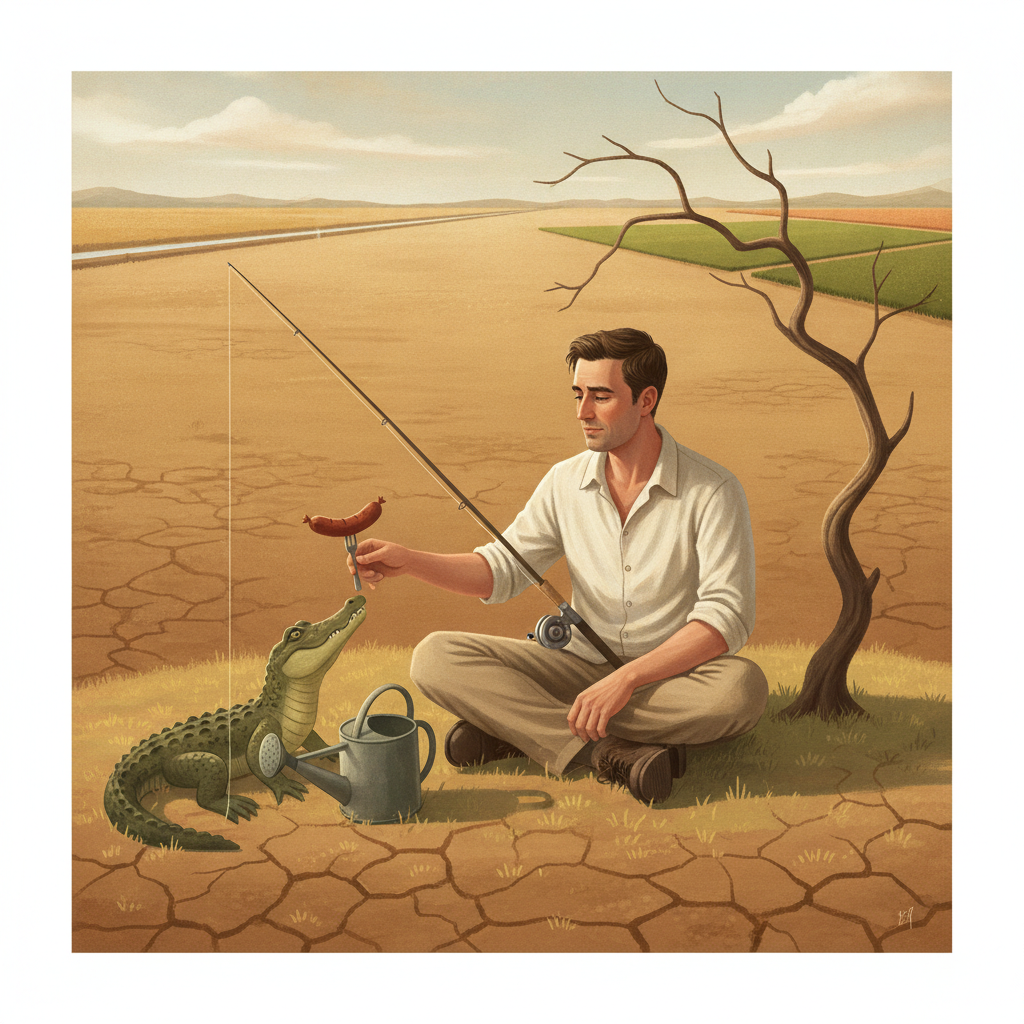
A man kept finding an alligator in his yard. He fed it. He asked, reasonably enough, why it had come. The real answer was upstream and had nothing to do with him: the water that used to hold the animal had been drawn off for fields miles away, and the swamp had nowhere left to keep it. The gator was not the problem. It was the arrival. That distinction is the whole of what follows, because we are extremely good at feeding arrivals and remarkably bad at tracing them home.
The reason is not stupidity. It is that the arrival is the only part of the chain that presents itself to you. It shows up in the yard, it demands a response, and responding to it feels like competence. The cause is miles away, requires leaving the yard, and pays out nothing you can point to at the end of the day. So we build fences, we buy food, and we get very skilled at managing a symptom that was never going to stop arriving.
Francis Bacon and the Idols of the Frame
Francis Bacon wrote about idols, the ghosts of doctrine that settle into the mind and quietly shape what it can see. The danger he named was not bad data, which is at least the kind of problem you can go looking for. It was the frame itself: inherited without ceremony, accepted without question, and then mistaken for the world. A mind sitting inside a borrowed frame reports the frame’s furniture as fact. It cannot see the walls, because the walls are the only thing it has ever looked through, and a wall you have always looked through is indistinguishable from an open view.
Most of what gets called analysis is just rearranging that furniture with unusual care and calling the result insight. The rearranging can be rigorous. It can be quantitative. It can survive peer review and still never touch the thing that generated the arrangement in the first place. That is the same mistake the man with the alligator made, and it shows up in three very different rooms without changing shape.
Why AI Labs Now Ship the Harness, Not Just the Model
The first room is models. Zhipu’s GLM-5.3 now ships with its own coding plan and an agent harness called ZCode, which is to say a bundle of model plus the scaffolding that makes the model useful inside a real workflow. That pattern is becoming the norm rather than the exception. Labs that once shipped a weights drop and called it a release now ship the harness alongside it, and increasingly the harness is the part they talk about.
It would be easy to read that as a bundling tactic, a way to lock people into an ecosystem. It is something less strategic and more revealing than that. It is the slow admission that a model by itself is a chapter you cannot implement in isolation. The reasoning was always the easy part to demo and the hard part to run, and the gap between those two facts is where most of the disappointment of the last few years has lived. The connective tissue, the thing that keeps an agent on task across a long job with a hundred opportunities to drift, turns out to be the actual product. The benchmark score is the alligator. The harness is the water.
The Soft Quarter Is the Alligator
Markets run the identical error with more money at stake. A stock drops on a soft quarter and the story writes itself about the quarter, complete with a chart of the miss and a quote about execution. The quarter is the arrival. The cause is the demand curve nobody charted, or the inventory nobody counted, or the customer who quietly left months earlier without a press release. By the time the number is public, the thing that produced it has been finished for some time.
The obvious read is always the edge symptom, because the edge symptom is what gets published. The truer read is upstream and almost never in the headline, partly because upstream causes are slow, unquotable, and hard to attribute to anyone in particular. The discipline here is not seeing more numbers, which is the reflex every trading desk already has covered. It is knowing which number is the messenger and refusing to argue with the messenger.
The second room is systems design, where the same line shows up in engineering language: you cannot pull one piece out and call it the whole. A payments stack is not the API, however much the documentation implies it is. It is the auth, the reconciliation, the dispute flow, the latency budget, and the human who answers at three in the morning when the ledger lies. Take one of those away and the thing still looks like a payments stack right up until the moment it isn’t, and at that moment it is just a door someone walks through. The same holds for a book, a model, a company, or a team. The parts only mean something inside the system that carries them, and a part evaluated outside its system will be evaluated on the wrong criteria every time.
The third room is the one nobody posts about. Most of us are harder on ourselves than anyone who has ever actually met us would be. We keep a running tally of the ways we fell short, we update it daily, and we feed it with an attentiveness we rarely give anything else. That cruelty is its own arrival. The cause sits upstream, older, quieter, and almost never inspected, because inspecting it means leaving the yard and the yard is where the pain is. So we treat the symptom closest to hand, which is the thought currently in our head, and never walk back to whatever sent it. The reflex that drains the swamp and then resents the gator is precisely the reflex that loops the criticism inward and calls it standards.
Walking Upstream Instead of Building a Higher Fence
Notice the shape all three share. A problem appears at the edge. We respond at the edge. The edge is where the pain is legible, so the edge is where the effort goes, and the effort is real effort honestly spent. Meanwhile the cause lives somewhere we would have to leave the yard to find. Leaving the yard is work with no immediate output. Feeding the gator is a motion that looks like work and produces a feeling of having done something, which is why it wins nearly every time it is offered.
The disciplines that actually hold, whether in an agent harness or in a life, are built on the unglamorous habit of asking where the water went before deciding what to do about the visitor. That question is unpopular for structural reasons rather than intellectual ones. It does not produce a screenshot. It does not ship a feature. It does not fit in a status update, because its output is a change in which problem you are solving, and most of the time that change is the entire game while looking like nothing at all.
There is a gentler version of this worth naming, because the upstream habit can curdle into a hunt for someone to blame. The point of tracing things home is not to assign fault to the source. The point is to stop spending yourself on arrivals. Once you see that the gator is a messenger, you can stop fearing it, stop feeding it, and stop building a higher fence around a yard that was never the issue. You can walk upstream instead. The work gets smaller and the results get larger, which is the only trade worth making anywhere. Build for the system, not the symptom. The gator was always just the messenger, and the message was never about the gator.
Leave a Reply