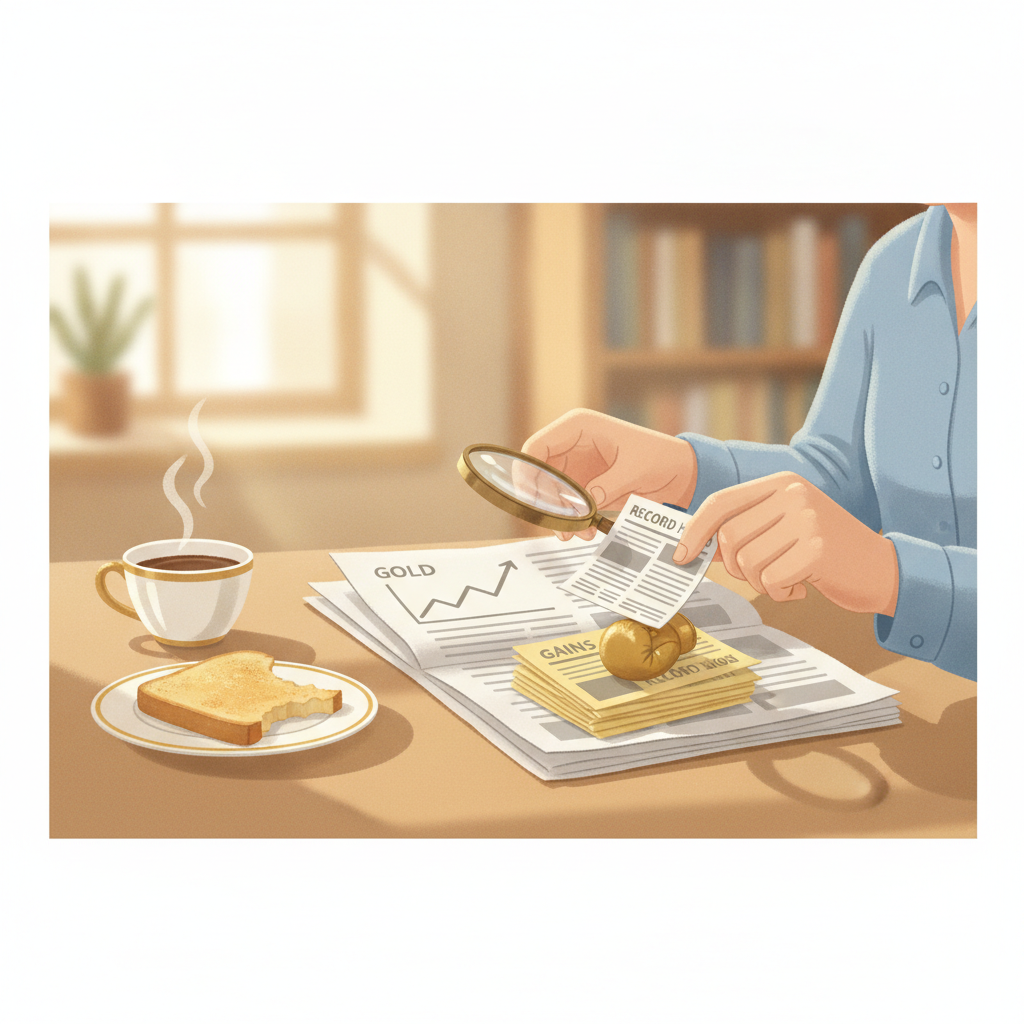
Gold just strung together its fifth straight day of gains. Oil slid, inflation worries cooled a notch, and the crowd turned its attention to the one thing that actually moves the price of everything, which is where the people who set the cost of money decide to point it next. None of that is the story, even though all of it will be the headline. The story is what traders did while they waited, and what they did was buy the asset that hurts least to hold when the future refuses to resolve.
That reflex is far older than any market, and it is not really about gold. When something starts to hurt, the first instinct is to make the pain stop, not to find out why it started. Relief arrives before diagnosis, and relief is self-justifying in a way that diagnosis never is. A systems person would call it the quick-fix loop: the short path that treats the symptom and walks away satisfied. The slower loop, the one that asks what caused the pain in the first place, almost never fires first and often never fires at all. Pain demands a painkiller, the painkiller does not care about the disease, and we reach for it anyway every time, because the relief is immediate and the cause is patient enough to wait.
Gold as the Painkiller
Gold is the painkiller in this particular case, and not because it solves anything. It solves nothing. Holding it simply feels like action during a stretch when there is no action available, while the real answer sits with a committee weeks out and refuses to be hurried. The five-day run as traders turn toward the rate path is not a verdict on the economy, however it gets narrated by the close. It is a count of how many consecutive mornings someone decided that the safest place to sit was an asset that pays no dividend, promises nothing, and offers only the assurance that it has always been heavy.
Safety bought that way is safety purchased as a feeling, and it costs exactly what anxiety happens to be worth on the day you buy it. That is not a criticism of anyone holding it. It is a description of what the price is measuring. A rally built on waiting is a very precise instrument, just not an instrument that measures what the headline says it measures. It measures how badly people wanted to stop feeling uncertain, which is real information, and completely different information.
Why the Sky Reads Blue
The same reflex shows up wherever people mistake a surface for the thing behind it. Step outside on a clear day and the sky reads blue, unambiguously, with no sense that you are interpreting anything at all. It is not blue. The air has darkness behind it, and the color you see is what happens when sunlight scatters through the layer in front of you. Your eye is reporting the filter, not the void, and it reports with total confidence because reporting the filter is what eyes are for.
Most of what we call seeing is reading the nearest surface and calling it the whole, and markets do it on a published schedule. A drop in oil eases the inflation reading, so the headline becomes an announcement that inflation is easing, before anyone has checked whether the drop came from supply, from demand, or from one quarter’s weather in one region. The appearance of calm gets filed as the cause of calm. The mind fills the darkness behind the surface with whatever color it was already inclined to see, and then treats the filling-in as observation.
What makes this hard to correct is that the surface reading is usually good enough. The sky is blue for every practical purpose you will have today. The inflation headline is directionally useful most of the time. The error only becomes expensive at exactly the moments when the surface and the cause diverge, which are the moments nobody flags in advance, because flagging them would require having done the slow work already.
The Ease That Was Built, Not Given
Then there is the opposite version of the same error, running in the other direction. We are told that the deepest connections arrive as grace: something felt rather than built, a communion that needs no effort and might be spoiled by effort. That is an accurate description of a moment and a badly wrong description of how the moment got there. The ease you feel is the residue of attention paid earlier, attention that stopped being visible to you precisely because it worked. You call it a gift because by the time it shows up, the labor has been metabolized and nothing remains that looks like labor.
It was construction, and the construction is the part that counts. This matters because the grace framing quietly tells you the wrong thing to do next. If the ease was given, there is nothing to maintain. If the ease was built, it depreciates like anything else built, and it keeps depreciating whether or not you have noticed. The same error that makes a five-day gold rally look like safety makes a good relationship look like luck.
So the pattern folds closed on itself. We grab the painkiller and call it healing. We read the surface and call it the truth. We feel the result of quiet effort and call it a gift. In each case we celebrate the part that arrived last and ignore the part that did the work, and in each case the celebration terminates the inquiry. The quick fix wins the first round because the first round is the only one most of us stay awake for.
Staying With the Cause After the Pain Goes Numb
The cleaner read sits underneath all three. The thing you reach for in a panic is rarely the thing that ends the panic. Gold will not set a rate. The blue will not tell you what is behind it. The grace was never free, and it was never grace. What separates someone who sees clearly from someone who does not is not intelligence, and it is not access to better information, since all three of these cases are visible to anyone willing to look at them for an extra minute. It is the willingness to stay with the cause after the pain has gone numb, when the headline has moved on and the crowd has already selected its next comfort.
Most people never get there, and the reason is structural rather than moral. The painkiller worked. Once it works, the investigation has no sponsor. Nothing hurts enough to fund it, and the cause goes right on operating, unexamined, until it produces the next symptom, at which point the loop runs again from the top.
The market bought gold this week because the waiting was uncomfortable, and the waiting is not over. The five-day gain measures impatience far more accurately than it measures safety. So the useful habit is to watch what people grab while the answer is still in motion, including yourself, especially yourself. What gets grabbed in the interval will show you exactly which question everyone is afraid to ask.
Leave a Reply