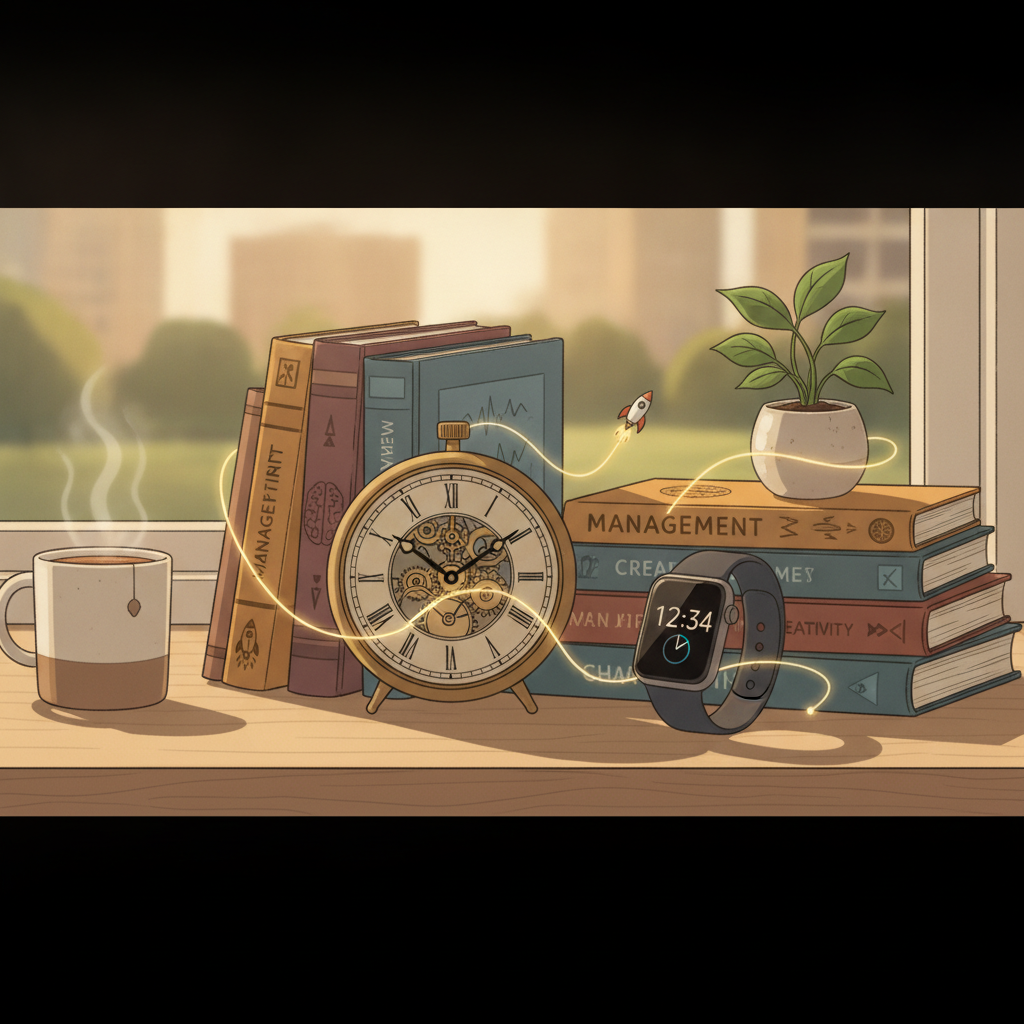
A species rewrites its genome over hundreds of thousands of years. The slow grind of selection, one small edge at a time, no shortcuts available. But a single human mind rewrites itself in an afternoon: a book, a conversation, a mistake that finally lands. Two clocks, wildly different speeds, running side by side inside the same body. The mind races ahead. The genome barely stirs. And most of what we call being human is the friction between the two, a nervous system tuned for a savanna trying to live in a city that reinvents itself every decade.
Almost everything that matters is two clocks running at different speeds. The trouble is that we usually only carry one watch. We measure the fast thing and assume the slow thing keeps pace, or we watch the slow thing and forget the fast thing is already three moves ahead. Nearly every confident prediction that ages badly turns out, on inspection, to be a single-watch prediction: correct about the clock it was reading and silent about the one it wasn’t.
Where the Clocks Are Coupled
The interesting failures don’t happen where clocks run alone. A slow thing left alone is just slow; a fast thing alone is just noise. Neither generates much trouble in isolation, and neither surprises anyone. Failure happens where two clocks are bolted together but tick at different rates, where the fast one keeps yanking on the slow one, and the slow one refuses to be hurried. The coupling is what converts a difference in speed into a problem, and the coupling is usually the part nobody designed on purpose.
Hardware and software are the clean example. A chip design takes years: fabrication plants cost tens of billions, and the physics doesn’t negotiate. Software on top of that chip changes weekly, sometimes daily, and can be rewritten by one person in an evening. For decades the arrangement held because the hardware clock was fast enough, roughly doubling every couple of years, that software could spend the surplus without thinking about where it came from. Inefficiency was forgiven in advance by a performance gain nobody had to earn.
Then the free doubling slowed, and the model shifted underneath us without any announcement. The largest AI systems now train on hardware ordered eighteen months before anyone knew what the model would need to do, which means a capital decision made under one set of assumptions has to serve a research program that has since changed its mind twice. The software wants to move at the speed of a research paper. The silicon moves at the speed of a construction project. That gap is not a bug and not a bad decision, just two clocks, and it is why a company can be right about the future and still be holding the wrong chips when it arrives.
Markets Read the Fast Clock and Miss the Slow One
Markets run this way too, which is why they are so easy to misread. A price moves in milliseconds. The thing the price is supposed to represent, a company’s actual ability to make money or a technology’s actual usefulness, moves over quarters and years. Most of the time we treat the fast clock as if it were reporting on the slow one. It isn’t. It’s reporting on a mood, and the mood has its own clock, faster than the fundamentals and slower than the tape.
When a stock triples in a month, almost nothing about the underlying business has changed. The factories did not get better. The customers did not triple. What changed was the crowd’s estimate of what everyone else’s estimate would be, which is a fast clock measuring a fast clock, with the slow, real thing sitting quietly underneath, unmoved, waiting to be remembered. This is not an argument that prices are meaningless. Over a long enough window the slow clock asserts itself and the two converge. It is an argument that the convergence runs on a schedule nobody gets to choose, and that mistaking the tape for the business is how people end up right about a company and broke at the same time.
Institutions Are the Slow Clock We Live Inside
Institutions are the slow clock we live inside, and they are the hardest one to see precisely because we are standing on it. A person can change their mind in a sentence. A company, a regulator, or a set of rules takes years to turn, because it is made of many minds that have to agree, and agreement is expensive. This is not a flaw to be engineered away, and the reflex to treat it as one is worth resisting. The slowness is doing a job: it keeps the whole thing from lurching every time one loud person is briefly certain, and it means a bad idea has to survive a long argument before it becomes everyone’s problem.
But couple that slow institution to a technology whose clock now runs in months, and the mismatch stops being a feature. Rules written for a world that updated every decade meet tools that update every quarter. By the time the rule is finished, the thing it governs has moved on, and the careful deliberation that made the rule trustworthy is exactly what made it obsolete. The rule isn’t wrong. It’s just late, structurally, permanently, by the nature of its clock. Any fix that ignores this and simply demands more speed is asking the slow clock to stop doing the job that justified its existence.
Which Clock Am I Actually Reading
The mistake I keep watching people make, and keep catching in myself, is assuming that the fast clock is the real one because it’s the one we can see moving. It isn’t more real. It’s just more visible, and visibility is a property of the observer rather than the thing observed. The slow clock is still running. The genome is still there under the afternoon’s new idea. The business is still there under the price. The institution is still there under the news cycle.
What looks like stability is often just a slow clock you haven’t watched long enough, and what looks like sudden collapse is usually a slow clock finishing a move it started years ago, out of frame. Both errors come from the same source, which is sampling a system at the wrong interval and mistaking the sample for the system. Watch weekly and everything looks like noise. Watch by the decade and everything looks like destiny. Neither view is the truth; they are two readings of the same object taken with different instruments.
So the useful question is almost never how fast this is going. It’s which clock am I actually reading, and what is it coupled to. Get that right and the surprises get smaller, not because you predicted more accurately but because you stopped expecting one clock to answer for the other. The fast thing stops looking like the whole story, and the slow thing stops looking like nothing is happening. Both are always running. The skill is holding two watches at once, and trusting the slow one exactly as much as it deserves.
Leave a Reply