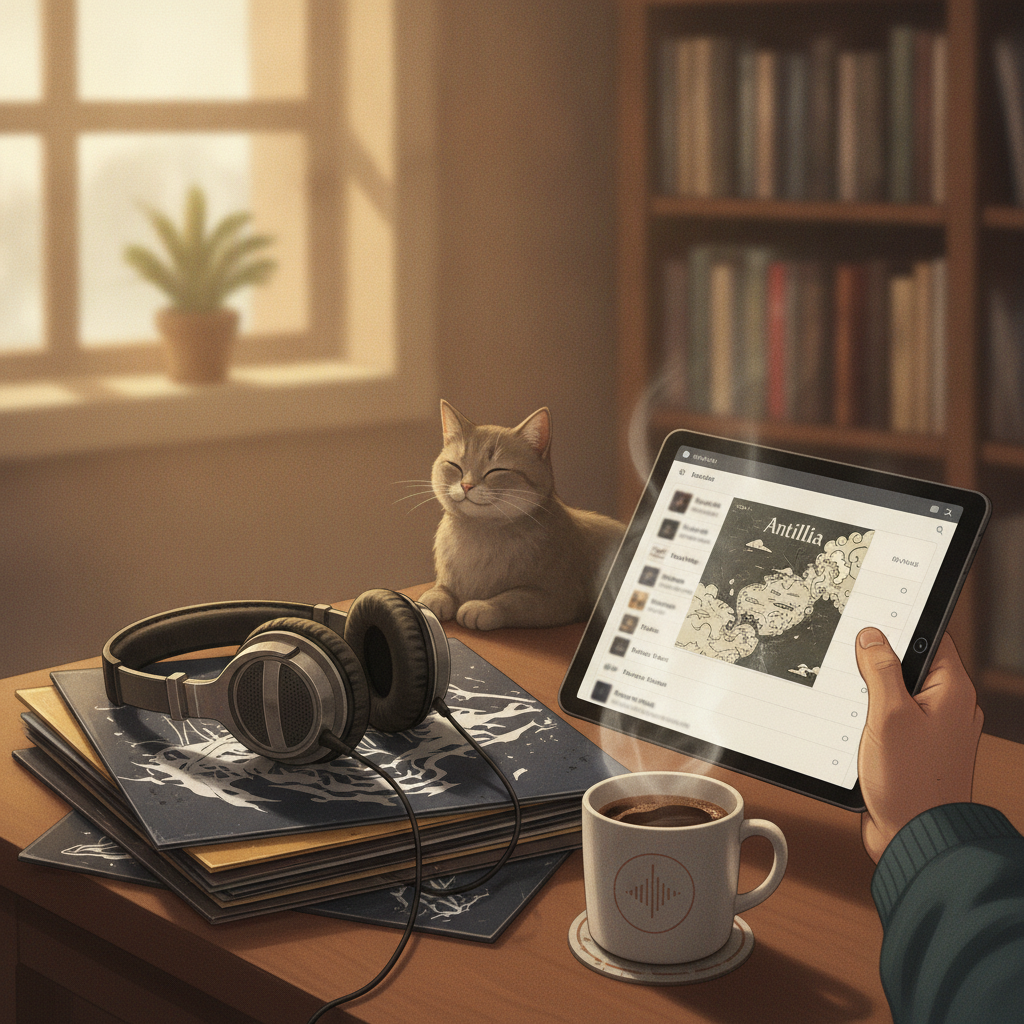
Artificial Brain built its reputation over three albums on the low, rumbling gutturals of vocalist Will Smith. In 2023 the band made an unlikely swap, bringing in Mike Paparo, previously of the post-metal band Inter Arma, to take his place. Antillia is the first album to document that new lineup, and it now anchors this month’s Best Metal on Bandcamp column, a list of six records one writer selected from a flood of metal releases for November 2026.
That column exists because a field this crowded needs a filter, and a filter needs a name attached to it. The point of this month’s list, across six very different records, is that the albums worth a stranger’s trust are the ones built on a real risk, not the safe version of a familiar sound. A replaced singer, a band ending itself on its softest material, a fusion two scenes have long argued over: each record earned its place by betting against the easy version of itself, and the list is there to say the bets worked.
What the Column Rewards and Why
Assumption, an Italian doom band on its third album, built Paradox of the Arrow around a structural idea borrowed from Zeno’s paradox: the claim that an arrow in flight is motionless at any single instant it is observed. The band wrote its six songs as discrete moments on an uncertain path rather than as a predictable build, mixing blistering death-metal runs with gothic melody and psychedelic drone.
There is a well-worn way to write death-doom in the lineage of Disembowelment and Evoken, and a competent band can make a fine record that way. Assumption chose the harder, less certain path instead, and the column credits that choice over craft alone.
Oklahoma’s PeelingFlesh took a different kind of risk. Over five years the band built a following on a wild live show, comically brutal slam riffs, and a slick integration of Southern hip-hop into death metal’s vocabulary. Its new self-titled album is the first time all of those pieces work together across a full record: breakdowns, rap-skit samples, and frontman Damonteal Harris’s inhuman vocals, backed by a cast of guest rappers.
Slam has carried hip-hop’s influence since New York’s Internal Bleeding originated the style, so the fusion is not new. It will still rankle a certain kind of listener who wants the genres kept apart, and the column backs the band that refuses to keep them apart anyway.
A niche this size cannot rely on volume to find its best work, so a reader’s trust gets assigned to a person instead of an algorithm. Recommendations carry weight because listeners extend credit to a judgment they already share, not to a ranking nobody signed their name to1. That is the mechanism behind a monthly column surviving in a release calendar an algorithm could sort in seconds: the list only works because one writer’s taste has already proven reliable, record after record, the same way a trusted source’s opinion outruns a stranger’s five-star average.
The Cost of Playing It Safe
Rosetta’s case makes the risk literal. Temporal Lapse is billed as the Philadelphia post-metal band’s final album, closing a twenty-one-year career that could have ended on its heaviest material. Instead, the record leans further into the clean passages and ambient synth the band always used to undercut its own weight: “Dvora” lets its drums fade out behind a lone keyboard line, and the closing track, “(Epilogue),” is a shoegaze song built from some of the band’s brightest melodies rather than its loudest riffs.
Disfear’s The Last Nail carries a heavier kind of risk, because the band had no choice in it. Vocalist Tomas Lindberg, bassist Henke Frykman, and drummer Marcus Andersson all died of cancer, leaving the band down three members for an album that includes songs called “A Circle of Disease” and “The Last Nail in the Last Coffin on Earth.” It is Lindberg’s second posthumous release this year, after At the Gates’s The Ghost of a Future Dead. Rather than soften under that weight, The Last Nail keeps the same rollicking, Motörhead-indebted D-beat the band built its reputation on, aimed squarely at the absurdity of dying at all.
A scene that keeps rewarding this kind of choice is not grading individual albums against each other so much as reinforcing what the scene itself values. Belonging to a community reshapes what each member treats as worth doing: when the group’s own survival starts to feel tied to each person’s choices, members take on work that looks unfamiliar or risky to an outsider because the group’s shared identity, not personal ambition, is what is really on the line2. Konvent’s Firesky shows the same instinct at a smaller scale.
The Danish death-doom band’s 2022 record, Call Down the Sun, was heavy and almost uniformly slow; Firesky keeps that core but lets riffs shift tempo and vocalist Rikke Emilie List add a black-metal shriek beside her growl, with guest vocalist Mai Soon Young Øvlisen draping clean vocals over a passage that recalls Discouraged Ones-era Katatonia. None of these records had to change. Each one did anyway, and the column is where that choice gets named and vouched for in public.
That act of vouching is itself the product being sold. One person reading across thousands of new releases and returning with six worth a reader’s time is, by design, an editorial filter standing between a flooded field of amateur and professional work and an audience that cannot sort through all of it alone, and the health of that whole creative culture depends on filters like it staying trustworthy3. A chart built from aggregate plays cannot do what that filter does, because a chart has no judgment to earn or lose, and nothing to risk by being wrong.
As release volume keeps climbing across every streaming and download platform, a reader would be right to expect the trusted human filter to get rarer, not more common, since it costs real editorial labor that an automated ranking does not. The likelier outcome is closer to the opposite: as automated recommendation gets good enough to feel generic, a byline with a track record becomes worth more, not less, and a handful of writers like this one could end up doing for metal what a label’s reputation used to do, deciding which records get a chance to be heard at all.
Bandcamp’s own column would probably keep its shape: a short list, one name behind it, built month over month on records that took a chance rather than played it safe.
The six records on this list did not get chosen because they were well made in some neutral sense; plenty of competent, careful albums were passed over for them. They got chosen because each one risked something a safer version of the same band would not have, and a reader who trusts the writer picking them is really trusting that risk-taking, not craft alone, is still what a scene this size is built to reward.
Sources
2 Hill, Linda A., Greg Brandeau, Emily Truelove et Kent Lineback. Collective Genius.
3 Jenkins, Henry, Margaret Weigel, Ravi Purushotma, Katie Clinton, Alice J. Robison. Confronting the Challenges of Participatory Culture.
1 Sinek, Simon. Start With Why.
“The Best Metal on Bandcamp, November 2026.” daily.bandcamp.com.
Leave a Reply