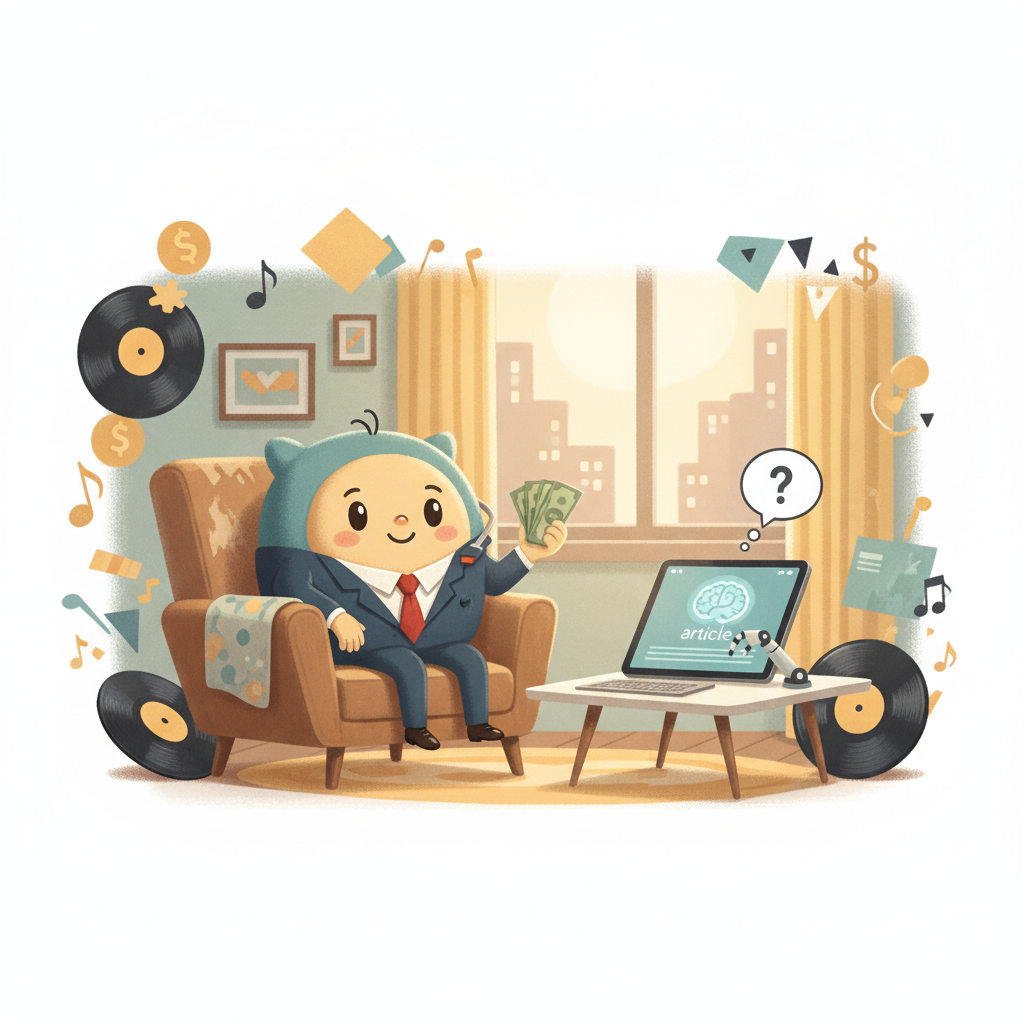
Private equity firms are buying music catalogs the same way they buy anything that throws off cash flow. Across the page, an AI agent’s byline appears beneath a story where no writer signed on. Both moves answer the same question in the same way: who gets paid when cultural output no longer requires paying creators?
Attack Magazine asks whether private equity is destroying music production, and the answer points past any single firm to a shared mechanism. The buyers acquire catalogs for their cash flows, then seek the lowest-cost way to extract more of them. A Bluesky post from @knibbs.bsky.social covering Wired’s AI byline reporting shows the same logic applied to the act itself. The first captures value through ownership, the second through substitution, but both expand into every place where output can be produced without compensating the original creative act.
George Reisman, writing in Production Versus Consumption, put the mechanism in terms of houses: “A given number of brick houses requires a larger supply of capital goods than the same number of wooden houses of the same size; the bricks or any more expensive material constitute a larger supply of capital goods because a larger quantity of labor is required to produce it.”
The expensive input absorbs more labor, more capital, more compensation. The cheaper substitute absorbs less. When that substitute is available, it expands to fill all available production space, not because it is better but because it is cheaper. Human creativity in the brick-house sense, paying the maker directly, becomes the expensive material, and AI, PE-owned assets, and automated processes become the wood.
This reframes what the headline debate misses. It is not that automation replaces individuals one at a time, or that finance extracts surplus from existing works. It is that the economic relationship between creation and compensation has been severed at every point where a cheaper substitute can capture value. The creator of the brick house still exists, but fewer get built because the market now prices the wood.
If the mechanism keeps running, the boundary between input and output could collapse. Capital-backed platforms may acquire not only finished works but the training data and generative processes behind them, feeding models that produce new songs, which the same firms owning the input then license back. The wood becomes a nursery for more wood, and the brick house rarer still.
The most expensive step in culture is creation, so culture routes around it.
Leave a Reply