In 1999, Elia Kazan received an honorary Oscar for a career in American theater. He had testified before Congress in 1952 and named eight artists as communist affiliates, and those eight were blacklisted for decades. Protesters outside the ceremony held signs calling him a snitch. His 15-year-old granddaughter watched it all on television, and her father told her that the old man’s feelings had shifted over the years and that hers might too.
Zoe Kazan spent the next two decades declining to test that. A middle-school teacher asked whether Elia Kazan was her grandfather, and she said no. A reporter at Yale, supposedly writing about September 11, asked about her family instead. She called her father in tears afterward and still describes that interview in the harshest terms.
Her career pointed the other way, and she built it well. The case for that strategy is not sentimental. Her grandfather’s work is load-bearing in American acting, and competing with it would be a waste of a life.
The book came due
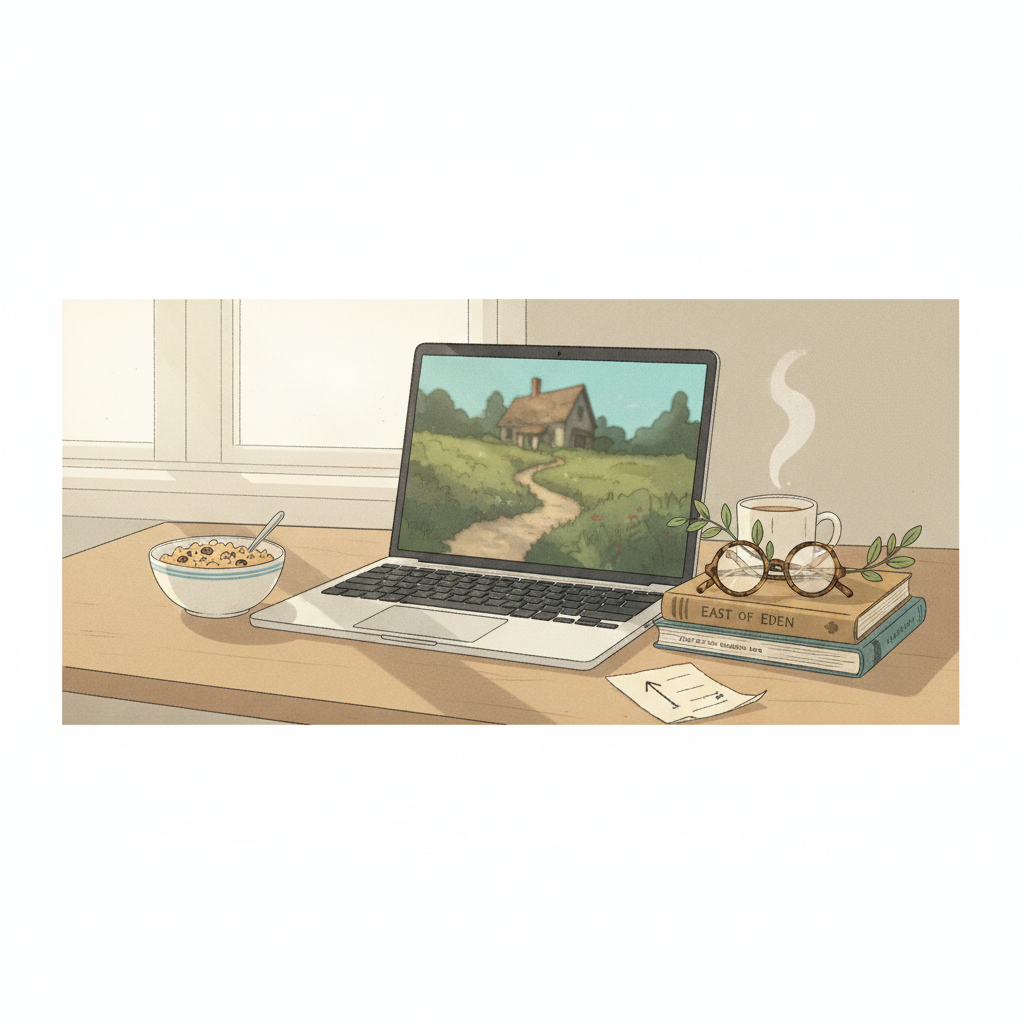
East of Eden, which her grandfather directed in 1955 with James Dean, had belonged to her since she was fifteen. She read it in one sitting and felt ownership on the spot. She asked her agents to call if the rights ever came free. When they did, in 2019, she was on a set in Australia and answered the text with the word yes five times in a row, plus a correction of a typo.
Her seven-episode version premiered on Netflix on October 1. Vulture’s profile of Kazan shows how superstitious she was about her grandfather’s film. She refused to watch it while she wrote, and she finally saw it on the flight to New Zealand, where the show was shot because California had become unaffordable. It turned out to be a loose reading of one corner of a 600-page novel, and her relief worked as permission.
Her grandfather built his film from the final quarter of the book and pushed Cathy Ames to the edges. Kazan took the whole novel. She cut the Hamiltons because she could not bear to lose Tom Hamilton, and she cut the racial slurs because the twentieth century does not need them again. She gave Lee, the Trasks’ servant, an entire life after he leaves them, which she described as closer to a Wong Kar-wai film than to Steinbeck.
Florence Pugh had to drag herself bloody across a field in the first shot, and Kazan cared more about making a monster watchable than about making her likable. The same instinct shows in how she handled an antique quilt while she edited. Its most common nineteenth-century motif was a spinning hooked cross that nobody can look at plainly anymore.
She did not throw the quilt out. She cut patches from other quilts and sewed them over the offending shapes until the object read differently. She said she was adjusting it for the moment we are all living in.
The work was not what surprised her most. What surprised her was that she ended up talking about her grandfather in public, with twenty years of family silence burned out of her by the doing of it.
Two ways out
Anyone who inherits something they did not choose faces one question: what to do with it. Kazan’s answer is engagement. She walked into the shadow, took the book her grandfather filmed, and built something out of the medium he defined. The Electronic Frontier Foundation’s answer is exit. Its Opt Out October guide for 2026 skips the settings panel and calls for substitution. That means a different operating system, a different social network, and different AI tools, plus explicit refusals to let those tools train on what you write.
The foundation admits the difficulty in the same breath as the necessity. The large platforms have installed themselves as defaults, and the alternatives are genuinely hard to find. Leaving a platform still requires a device, a network, and an account, and every guide to leaving is published on the web.
Engagement has no outside either. Kazan could not confront the legacy in any form other than the one her grandfather built, and the confronting cost her the family silence she had kept since she was a teenager. Neither path is clean, so the choice is not between accepting and refusing. It is a choice about what to spend.
What an inheritance costs
That constraint is arithmetic before it is moral. In Capital in the Twenty-First Century, Thomas Piketty argues that when the return on capital outruns the growth of the economy, inherited wealth compounds faster than earned income. The distribution then drifts back toward the arrangement we thought we had retired. His point about people born in the 1970s and 1980s is not about billionaires. “Inheritance is playing a larger part in their lives, careers, and individual and family choices than it did with the baby boomers.”
A famous last name behaves like that capital. It pays a yield whether or not the heir does anything, in the form of access, introductions, and a floor under failure. It also charges interest in expectations the heir never agreed to. Kazan has said that her work is predicated on the way her grandfather changed American theater. She has never felt any need to compete with that, because it is too big to compete with.
What she arrived at is worth more than the argument. She did not decide her grandfather was good or bad, and she did not decide he was forgivable. She decided what to do while the contradiction stayed unresolved. Her tolerance for his choices has gone down across two administrations, she says, and her empathy for him has remained.
The quilt works the same way. You do not throw out the object, and you do not pretend the symbol meant nothing. You cover the part that is hurting people now, keep the rest, and go on using it. An inheritance cannot be refused or settled, only spent on purpose.
Leave a Reply